Band 5.5 IELTS Writing Task 1 Model Answer
Overall Band Score: 5.5 · Cambridge IELTS 13 · 2026-11-28
IELTS Writing Task 1 question
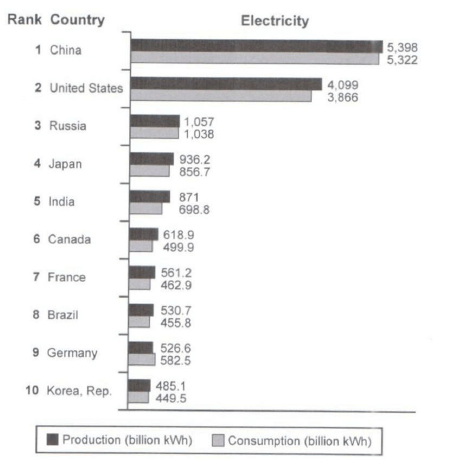
The bar chart below shows the top ten countries for the production and consumption of electricity in 2014.
Summarize the information by selecting and reporting the main features, and make comparisons where relevant.
Student answer (Band 5.5)
The given chart from 2014 shows that China produces and consumes the most electricity in the world. China produces 5398 billion Kwh of electricity and consumes just a bit less then that. It is because the China has largest population living in one of the largest lands for a country. They have built a lot of small or large scale dams for the production of electricity. After China, America is the largest electicity producer with over 4000 billion kWh of electricity whereas consumes relatively lower. They have stored electricity for backup as well.
The other top 8 producers and consumers are Russia, Japan, India, Canada, France, Brazil, Germany and Korea Republic respectively. The amount of production and consumption of electricity varies from country to country.
One thing to note about Germany is that they consume more electricity than they produce. The less production might be due to limited resource like dams and more consumption might be the cause of using electricity for everyday use like cooking, electronics devices and also due to the rise of electic vehicles.
AI examiner evaluation
| Criterion | Band |
|---|---|
| Task Achievement / Task Response | 5.5 |
| Coherence and Cohesion | 5.5 |
| Lexical Resource | 5.5 |
| Grammatical Range and Accuracy | 5.5 |
| Overall | 5.5 |
Task Achievement / Task Response: Band 5.5
You identify the leading countries and correctly note that China and the United States produce and consume far more electricity than the others. The observation that Germany is the exception, consuming more than it produces, is also accurate. However, the response only partly summarises the chart: it gives no clear overview of the overall pattern across all ten countries and provides little comparison among the middle-ranking nations. The explanations about China’s population and dams, US electricity storage, and Germany’s resources and electric vehicles are not shown by the chart, so they take space from reporting its data. To strengthen the response, focus on the figures and comparisons, such as the sharp drop after the US and the generally higher production than consumption.
Coherence and Cohesion: Band 5.5
The response has a basic paragraph structure, moving from China and the United States to the remaining countries and then Germany. Linking phrases such as “After China” and “One thing to note” help signal these shifts. However, the progression is limited: the second paragraph mainly lists countries without explaining how their figures compare, and the final paragraph shifts into speculation rather than developing the chart summary. Some connections between claims are also unclear, particularly “They have stored electricity for backup as well,” which is not clearly linked to the comparison. Organise the report around an overview followed by grouped comparisons, and use references that make each country or figure unmistakable.
Lexical Resource: Band 5.5
You use relevant chart vocabulary, including “produces,” “consumes,” “production,” and “varies,” and the reader can generally understand the main points. However, the range is limited and some expressions are informal or imprecise for an academic report, such as “just a bit less,” “a lot of,” and “One thing to note.” There are also noticeable spelling errors, including “electicity” and “electic,” and awkward collocations such as “largest lands for a country” and “limited resource like dams.” These choices reduce precision, especially when describing data. Use more formal reporting language and accurate terms for comparisons, quantities, and resources; avoid adding speculative explanations that require vocabulary beyond what the chart supports.
Grammatical Range and Accuracy: Band 5.5
You attempt both simple and more extended sentence forms, and most of the meaning remains understandable. However, errors recur in sentence construction and grammatical patterns. For example, “whereas consumes relatively lower” lacks a clear subject and uses an incomplete comparison; “It is because the China has largest population” has problems with the article and sentence structure; and “The less production might be due to limited resource” has an awkward comparative form and missing article. The response also relies heavily on straightforward statements, so the range of structures is limited. Practise complete clauses with clear subjects, accurate articles, and parallel comparisons—for example, “The United States produces more than 4,000 billion kWh, while its consumption is lower.”
See this exact question answered at other band scores. The same prompt compared across bands.
Browse more IELTS Writing model answers or get your own writing scored by the same AI examiner.