Band 5.0 IELTS Writing Task 1 Model Answer
Overall Band Score: 5.0 · Cambridge IELTS 13 · 2026-11-28
IELTS Writing Task 1 question
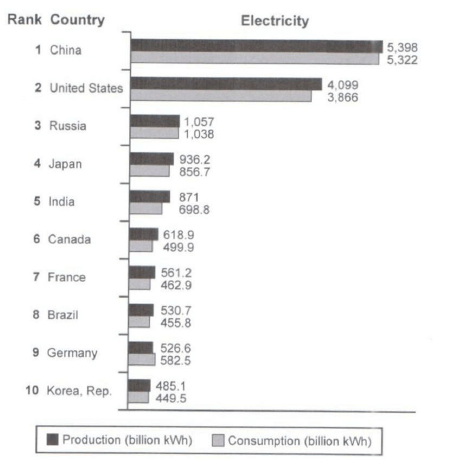
The bar chart below shows the top ten countries for the production and consumption of electricity in 2014.
Summarize the information by selecting and reporting the main features, and make comparisons where relevant.
Student answer (Band 5.0)
The chart illustrate the leads ten countries for the making and using of electricity in the year 2014, while the chart describe the rank of each country and how the electricity has been used among each country.
Firsly, in the year 2014 the electricity produced by chaina was 5398 while the coutry used 5322, the united state also produce 4099 kwh of electricity and make use of 3866 kWh, Rusia also produce 1057 kWh and make use of 1038, japan also produse 936.2 kWh and also make use of 956.7 out of the kWh produced, india also produced 871 kWh and later make use of 698.8kWh, in canada 618.9 kWt of elecricity were also produce and 499.9 kWh was later used, France also produce 561.2 kWh of electricity and make use of 462.9, Brazil produce 430.7 kWh and make use of 455.8,Garmany produce 526.6 kWh and make use of 582.5, in korea, Rep.485.1 kWh of elecricity was produce and 449.5 kWh of electricity were used
In the contrcst,germanny is the olny contry that use more kWh of electricity more than their production, china is the only contry that produce higher kwh of electricity among all listed country and corea production were drastically low in production to china and others
AI examiner evaluation
| Criterion | Band |
|---|---|
| Task Achievement / Task Response | 5.0 |
| Coherence and Cohesion | 5.0 |
| Lexical Resource | 5.0 |
| Grammatical Range and Accuracy | 5.0 |
| Overall | 5.0 |
Task Achievement / Task Response: Band 5.0
You report figures for most countries and identify two relevant comparisons: China has the highest production, and Germany is the only country whose consumption exceeds production. However, the overview is brief and does not clearly summarise the broader pattern, such as the large gap between the two leading countries and the much lower figures for the rest. There are also factual inaccuracies: Japan’s consumption is 856.7, not 956.7, and Brazil’s production is 530.7, not 430.7. The claim that Korea’s production was “drastically low” is vague and does not explain its position relative to the other lower-ranked countries. Select the main patterns, then support them with accurate figures.
Coherence and Cohesion: Band 5.0
The response has a basic structure, with an opening, a paragraph listing data, and a concluding comparison. This gives the reader some organisation, and words such as “while” and “also” help connect information. However, the long middle paragraph strings together nearly every country in one sentence-like sequence, so comparisons are difficult to follow. The final paragraph introduces useful overview points, but “In the contrast” does not connect smoothly to the preceding list, and the ideas are not developed in a clear order. Grouping the two leading producers together, then summarising the remaining countries and the Germany exception, would create clearer progression. Use full stops to separate comparisons and avoid repeating “also” for each country.
Lexical Resource: Band 5.0
You use relevant task vocabulary, including “produced,” “make use of,” “production,” and “consumption,” so the main topic is generally understandable. However, the range is limited and several expressions are repetitive or imprecise. “The leads ten countries” and “the making and using of electricity” are awkward ways to describe the chart, while “drastically low in production to China and others” does not express a clear comparison. Frequent spelling errors, including “chiana,” “Rusia,” “Garmany,” and “contrcst,” also reduce accuracy and can distract the reader. Aim for precise chart language such as “the ten leading countries,” “electricity generation,” and “consumption exceeded production,” and check country names carefully.
Grammatical Range and Accuracy: Band 5.0
The response communicates the general subject, but grammatical control is inconsistent. The opening has agreement errors in “The chart illustrate” and “the chart describe,” and the long data sentence contains repeated problems with verb forms and agreement, such as “the united state also produce” and “Brazil produce.” Sentence structures are mostly simple or joined by “and” and “also”; attempts to combine comparisons often become run-on sentences. Articles, plurals, and punctuation are also unreliable, as in “among each country” and the comma splice before “Germany.” Use a consistent past-tense pattern, for example, “China produced 5,398 billion kWh, while consumption was 5,322 billion kWh,” and divide the country-by-country details into shorter, correctly punctuated sentences.
See this exact question answered at other band scores. The same prompt compared across bands.
Browse more IELTS Writing model answers or get your own writing scored by the same AI examiner.