Band 6.0 IELTS Writing Task 1 Model Answer
Overall Band Score: 6.0 · Cambridge IELTS 13 · 2026-11-28
IELTS Writing Task 1 question
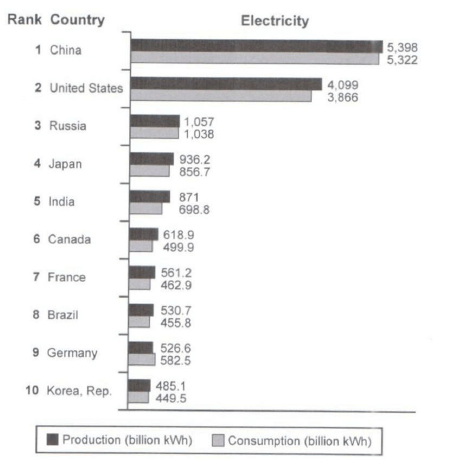
The bar chart below shows the top ten countries for the production and consumption of electricity in 2014.
Summarize the information by selecting and reporting the main features, and make comparisons where relevant.
Student answer (Band 6.0)
The bar graph represents the production and consumption of electricity by top ten countries in the world.
Overall, the graphs shows the production and consumption in billion kwh units. All the countries are almost equally consuming and producing electricity. China is the largest producer and consumer of electricity whereas the korea is the smallest producer and consumer of electricity.
China and USA both produces almost over 4000 billion kwh of electricity. Russia, Japan, India and Canada produces almost over 600 billion kwh of electricity where as France, Brazil and Germany produces less than 600 billion kwh of electricity. Korea is the only country which produces less than 500 billion kwh of electricity. China, Russia, Japan, India and korean use almost all electricity they produce and saves less than 100 billion kwh of electricity.
USA, France and Brazil save almost 100 billion kwh of electricity each out of they produced.Germany is the only country which consumes more than it produces that is, it produces 526.6 billion kwh of electricity and consumes 582.5 billion kwh of electricity.
AI examiner evaluation
| Criterion | Band |
|---|---|
| Task Achievement / Task Response | 6.0 |
| Coherence and Cohesion | 6.5 |
| Lexical Resource | 5.5 |
| Grammatical Range and Accuracy | 5.5 |
| Overall | 6.0 |
Task Achievement / Task Response: Band 6.0
You identify the main overall pattern: China leads both measures, Korea is lowest in production, and Germany is the exception where consumption exceeds production. You also make useful comparisons across groups of countries. However, some details are inaccurate or too broad. Korea is not the smallest consumer: Germany’s consumption is higher than its production, but Korea’s 449.5 billion kWh is lower than Brazil’s 455.8 and France’s 462.9. The claim that the USA, France and Brazil each save about 100 billion kWh is also imprecise; their production-consumption gaps differ, and the USA’s is substantially larger. The overview is relevant, but “all the countries are almost equally consuming and producing” needs qualification because Germany reverses the pattern and India has a notably larger gap.
Coherence and Cohesion: Band 6.5
The response has a clear overall arrangement: an introduction, an overview, and paragraphs grouping the countries and discussing differences between production and consumption. This gives the reader a logical route through the information, and linking expressions such as “Overall,” “whereas,” and “that is” help show relationships. To make the progression more controlled, organise the details around the most important comparisons rather than moving between broad production thresholds and consumption gaps. For example, the final paragraph could compare the countries with the largest surpluses and then contrast them with Germany. Some links are also awkward or unclear, particularly “out of they produced,” which interrupts the connection between the figures and the point being made.
Lexical Resource: Band 5.5
You use relevant chart vocabulary, including “production,” “consumption,” “largest,” “smallest,” and “billion kwh,” so the topic remains clear. There is some useful variation in how you describe comparisons, such as “whereas” and “more than it produces.” However, the range is somewhat repetitive, especially the repeated use of “produces” and “electricity,” and several expressions are imprecise or unnatural. “Save electricity” does not accurately describe the difference between production and consumption; “produce a surplus” would be more suitable. “The graphs” is also an inaccurate label for a single bar chart, and “korean” is not correctly formed as a country adjective. More precise comparison language would improve clarity and control.
Grammatical Range and Accuracy: Band 5.5
You use both simple statements and some longer sentences, including a contrast with “whereas” and a clause introduced by “that is.” Most of the intended meaning can be followed, but some grammatical errors recur. Subject–verb agreement is inconsistent in “China and USA both produces” and “Russia, Japan, India and Canada produces”; plural subjects require “produce.” The opening overview also has a mismatch in “the graphs shows.” There are problems with articles and sentence construction in “the korea” and “out of they produced,” while the missing space after “produced.Germany” affects punctuation. Aim to check agreement and build longer comparisons with complete, clearly connected clauses.
See this exact question answered at other band scores. The same prompt compared across bands.
Browse more IELTS Writing model answers or get your own writing scored by the same AI examiner.