Band 5.5 IELTS Writing Task 1 Model Answer
Overall Band Score: 5.5 · Cambridge IELTS 13 · 2026-11-28
IELTS Writing Task 1 question
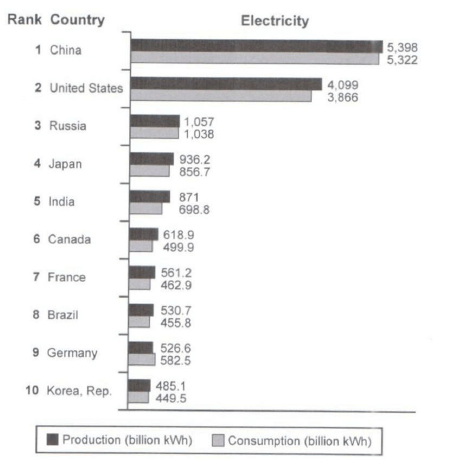
The bar chart below shows the top ten countries for the production and consumption of electricity in 2014.
Summarize the information by selecting and reporting the main features, and make comparisons where relevant.
Student answer (Band 5.5)
The bar graph compares the amount of electricity produced and consumed by several countries in 2014. Overall, China was the highest country producing and consuming electricity whereas Korea consumed lowest electricity. India is the fifth highest country in power production, considerably less than United states.
China is ranked at the top among other country with highest produced and consumed electricity at 5398 billions and 5322 billions respectively. United States is the second country with power consumption at 4099 kilo watts in 2014, while it consumed an overall electricity of 3866 KWh in the entire year. Russia and Japan consumed significantly less energy measured at 1057 and 936.2 kilo watts.
India is the fifth highest country with productionof 871 KWh of electricity and had a surplus of approximately 173 Kilo Watts due to lower consumption. Republic of Korea had the lowest country with electricity production at 484.1 Kilo Watts where as Germany was the second lowest with a marginal difference of 41 Kilo watts.
AI examiner evaluation
| Criterion | Band |
|---|---|
| Task Achievement / Task Response | 5.5 |
| Coherence and Cohesion | 6.0 |
| Lexical Resource | 5.5 |
| Grammatical Range and Accuracy | 5.5 |
| Overall | 5.5 |
Task Achievement / Task Response: Band 5.5
You identify the chart’s subject and give a relevant overview, noting China’s leading position and Korea’s low consumption; you also select useful comparisons involving India and the United States. However, coverage is partial because several figures are misreported or their measures are confused. For example, the United States’ production is 4,099, not its consumption, and Russia’s and Japan’s figures are presented as consumption even though the values given correspond to production. Germany is not the second-lowest producer: Korea is lowest, while Germany’s production is slightly above Brazil’s and its consumption is the only one to exceed production. Clarify the comparisons and report the correct series to make the main features more complete and reliable.
Coherence and Cohesion: Band 6.0
The response has a clear overall arrangement: an introduction and overview are followed by paragraphs covering the leading countries and then lower-ranked producers. This gives the reader a basic progression, and linking expressions such as “Overall,” “while,” and “whereas” help connect points. However, the organisation within the body is sometimes difficult to follow because production and consumption are not consistently distinguished. For instance, the United States sentence labels 4,099 as consumption, then gives 3,866 as consumption again, while the Russia and Japan sentence also blurs the measures. Grouping figures explicitly by production and consumption, and using clearer references such as “the corresponding consumption figure,” would make cohesion more dependable.
Lexical Resource: Band 5.5
You use a reasonable range of task-related terms, including “produced,” “consumed,” “surplus,” “ranked,” and “marginal difference,” so the topic is generally clear. However, several word choices and collocations are inaccurate or imprecise, which sometimes makes the data harder to interpret. “Kilo watts” and “KWh” are not the chart’s unit; it reports billion kWh. Phrases such as “highest country producing” and “had the lowest country” are also unnatural, and “power consumption” is used where the sentence describes production. Aim for precise chart language, such as “generated,” “consumed,” “ranked lowest,” and “billion kWh,” and check spelling and spacing in compounds.
Grammatical Range and Accuracy: Band 5.5
You attempt a mix of simple and more complex sentences, including a contrast with “whereas” and a cause-and-effect construction with “due to.” Most of the intended meaning remains understandable, but some grammatical errors affect clarity. For example, “China was the highest country producing and consuming” has an awkward comparative structure, while “Korea consumed lowest electricity” is missing an article and a natural superlative form. “India is the fifth highest country … and had a surplus” also shifts tense, and “Republic of Korea had the lowest country” has an incorrect sentence pattern. Use consistent past tense for the 2014 data and check articles, agreement, and sentence construction when comparing countries.
See this exact question answered at other band scores. The same prompt compared across bands.
Browse more IELTS Writing model answers or get your own writing scored by the same AI examiner.