Band 5.5 IELTS Writing Task 1 Model Answer
Overall Band Score: 5.5 · Cambridge IELTS 13 · 2026-11-28
IELTS Writing Task 1 question
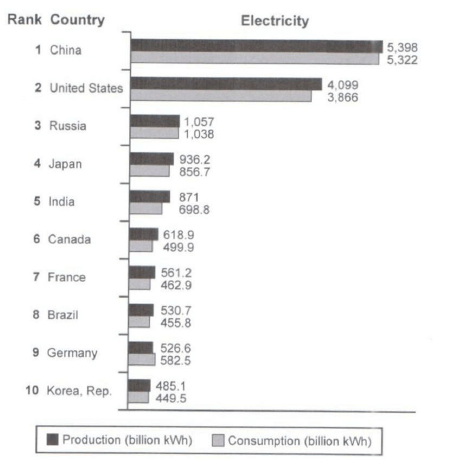
The bar chart below shows the top ten countries for the production and consumption of electricity in 2014.
Summarize the information by selecting and reporting the main features, and make comparisons where relevant.
Student answer (Band 5.5)
The Bar Chart illustrates the top ten regions who produce and consume electricity in the year 2014.
Overall, apart from Germany, all the countries consume less or at least the same amount of electricity they produce. Where China and USA tops the chart for both consumption and production. On the other hand all other countries remain on the moderate side.
Firstly, China and USA produce around 5398 billion kwh and 4099 kwh, respectively. And their consumption also remain on the top with 5322 and 3866, respectively. Then comes Russia, Japan and India with a moderate amount for both production and consumption. Where Russia produces 1057 billion kwh and consumes 1035 billion kwh. japan and India follow with the less value than russia with just around 936.2 billion and 871 billion respectively with the consumption of 856.7 and 698.8 billion respectively. After that, Canada, France, Brazil, Germany, and Korea, Rep. lies in the region of consumption between 480 billion to 620 billion and the consumption rate lies between 440 to 500 billion except Germany, their consumption is higher than their production thei consumption is 582.5 billion kwh where their production remains 526.6 billion kwh.
AI examiner evaluation
| Criterion | Band |
|---|---|
| Task Achievement / Task Response | 6.0 |
| Coherence and Cohesion | 6.0 |
| Lexical Resource | 5.5 |
| Grammatical Range and Accuracy | 5.0 |
| Overall | 5.5 |
Task Achievement / Task Response: Band 6.0
You identify the main pattern accurately: China and the United States lead both measures, and Germany is the exception to the general pattern of production exceeding consumption. You also include several relevant figures, including the leading countries and the middle-ranked group. However, some details are unclear or inaccurate: Russia’s consumption is 1,038 billion kWh, not 1,035, and the statement that the lower group’s consumption is between 440 and 500 overlooks Germany’s 582.5. The overview’s description of the remaining countries as being “on the moderate side” is also vague. To strengthen the response, make the scale contrast between the top two and the other countries explicit and report the lower-group comparisons more precisely.
Coherence and Cohesion: Band 6.0
The response has a recognisable structure, with an overview followed by a country-by-country account, and the sequence from the largest producers to the smaller ones is generally logical. Linking expressions such as “Overall,” “Firstly,” “Then,” and “After that” help guide the reader. However, some connections are mechanical or unclear. For example, “Where China and USA tops the chart” is a fragment, and the long final sentence combines several countries, ranges, and Germany’s exception, making the comparison difficult to follow. The repeated “respectively” also makes the figures dense. Use complete sentences and separate the lower-ranked countries from Germany so each comparison is easy to track.
Lexical Resource: Band 5.5
You use relevant task vocabulary, including “production,” “consumption,” “respectively,” and “higher than,” so the main comparisons are understandable. There is some variety in how you describe the data, but several choices are imprecise or unnatural for a chart report. “Regions” is not the right label for the countries, “moderate side” is vague, and “lies in the region of consumption” is an awkward way to describe a range. “Less value” is also less precise than language such as “lower figures.” Capitalisation and spelling are inconsistent, including “japan” and “russia.” Aim for concise, conventional chart language and use “billion kWh” consistently when giving figures.
Grammatical Range and Accuracy: Band 5.0
You attempt both simple and more complex sentence forms, and the meaning is usually recoverable. However, errors in agreement, sentence construction, and punctuation are noticeable. In “China and USA tops the chart,” the plural subject requires “top”; “their consumption also remain” should be “remains”; and “Where China and USA tops…” is an incomplete sentence. The opening “Firstly…” sentence also begins with “And,” leaving the figure statement awkwardly separated. The final sentence is overloaded and contains unclear pronoun reference in “their consumption.” Practise forming complete sentences around comparisons, checking subject–verb agreement, and dividing long sentences so that each has a clear subject and verb.
See this exact question answered at other band scores. The same prompt compared across bands.
Browse more IELTS Writing model answers or get your own writing scored by the same AI examiner.