Band 7.0 IELTS Writing Task 1 Model Answer
Overall Band Score: 7.0 · Cambridge IELTS 13 · 2026-11-28
IELTS Writing Task 1 question
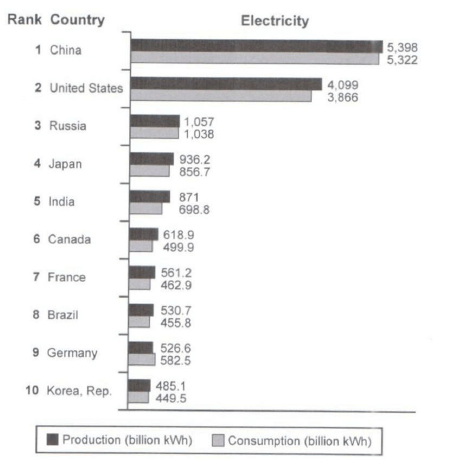
The bar chart below shows the top ten countries for the production and consumption of electricity in 2014.
Summarize the information by selecting and reporting the main features, and make comparisons where relevant.
Student answer (Band 7.0)
The bar chart illustrates the data of producing and consuming electricity in 2014 in particular ten countries.
The production of electricity in China and the United States was way higher than other countries, 5,398 billion kWh and 4,099 billion kWh, respectively. These two countries were also the greatest consumers as 5,322 billion kWh electricity was consumed in China in 2014 and 3,866 billion kWh electricity was used by the United States. Russia and Japan recorded similiar production at 1,057 billion kwh and 936 billion kwh,respectively, while their consumption was slightly lower than production at 1,038 billion kwh and 857 billion kwh, respectively.
Similarly, India produced 871 billion kWh electricity and used 699 billion kwh in 2014, compared with 619 billion kwh and 500 billion kwh in Canada. The production in France, Brazil, Germany, and Korea was almost the same at 561 billion kwh, 530 billion kwh, 527 billion kwh, and 485 billion kwh, respectively. A similar pattern can be seen in the consumption of these countries except Germany as this country used more electricity than the production at 582 billion kwh. The remaining countries France, Brazil, and Korea consumed lower than the production at 463 billion kwh, 456 billion kwh, and 450 billion kwh respectively.
Overall, the highest electricity was produced and consumed by China, whereas Korea generated the lowest and a small consumer as well.
AI examiner evaluation
| Criterion | Band |
|---|---|
| Task Achievement / Task Response | 7.0 |
| Coherence and Cohesion | 7.0 |
| Lexical Resource | 6.5 |
| Grammatical Range and Accuracy | 6.5 |
| Overall | 7.0 |
Task Achievement / Task Response: Band 7.0
The response selects the main features accurately: China and the United States dominate both production and consumption, while Korea is lowest in production and consumption. Most figures are reported correctly, and the comparisons between Russia and Japan, India and Canada, and the lower-ranked countries support the summary. The overview is present, although it would be stronger if it also highlighted the broad pattern that production exceeds consumption in nearly every country, with Germany as the exception. The phrase “a similar pattern” is slightly imprecise because Germany’s consumption is higher than its production, and the final overview could state this contrast explicitly. Overall, the key information is addressed and supported with relevant data, though the overview could synthesise the comparisons more fully.
Coherence and Cohesion: Band 7.0
The information is organised into a clear introduction, two body paragraphs and a concluding overview. The progression from the two leading countries to the middle and lower-ranked countries is logical, and linking expressions such as “respectively,” “Similarly” and “whereas” help connect comparisons. The use of “A similar pattern can be seen” also signals a relationship between production and consumption, although the Germany exception makes that reference somewhat imprecise. The final overview repeats the leading and lowest positions rather than drawing together the broader production-consumption pattern. To strengthen cohesion further, make the overview a more effective synthesis and ensure references such as “these countries” or “a similar pattern” point unambiguously to the intended comparison.
Lexical Resource: Band 6.5
The vocabulary is adequate for describing the chart, with useful terms such as “recorded,” “consumers,” “respectively” and “generated.” The writer also varies some wording for electricity use, including “consumed” and “used.” However, several choices are awkward or imprecise: “the data of producing and consuming electricity” is not a natural description, “way higher” is informal, and “the highest electricity” does not express the intended idea clearly. There are also spelling and presentation slips, including “similiar” and inconsistent capitalisation of “kWh.” These do not prevent understanding, but more precise collocations and a consistently formal register would make the description more fluent and controlled.
Grammatical Range and Accuracy: Band 6.5
The response uses a mix of simple and complex structures, including comparisons with “while,” “compared with” and “except,” and most sentences communicate the data clearly. Some grammatical control is evident in constructions such as “their consumption was slightly lower than production.” However, there are errors in sentence structure and article use, particularly in the overview: “Korea generated the lowest and a small consumer as well” lacks a complete parallel construction and an article before “small consumer.” The opening phrase “illustrates the data of producing and consuming” is also structurally awkward. Punctuation spacing is inconsistent, as in “kwh,respectively.” More consistently complete constructions and careful proofreading would improve accuracy while preserving the range of sentence forms.
See this exact question answered at other band scores. The same prompt compared across bands.
Browse more IELTS Writing model answers or get your own writing scored by the same AI examiner.