Band 6.0 IELTS Writing Task 1 Model Answer
Overall Band Score: 6.0 · Cambridge IELTS 18 · 2026-11-07
IELTS Writing Task 1 question
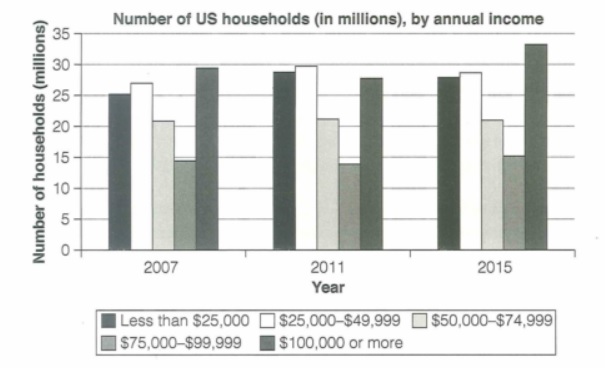
The chart below shows the number of households in the US by their annual income in 2007, 2011 and 2015.
Summarize the information by selecting and reporting the main features and make comparisons where relevant.
Student answer (Band 6.0)
The bar chart illustrates the amout of households in us across five different annual income groups, from 2007 to 2015.
Overall, it is clear that the figure for households earning $[redacted phone] or more recorded the highet amount in all three years, whereas $[redacted phone]9 stood at the lowest.Other three groups accounted a moderate number.
For households earning less than $25000 per year, the number stood at 25 milions in 2007, the figure incresed slightly by almost 4 millions in 2011, and in 2015 it decreased by 2 millions to around 26.5 milions. For $25000-$49999 earning groups started with more than 25 millions in 2007, by the end of period it climed up slightly to almost 28 millions. Those earning $50000-$74999 remained constant throughout the period.
Annual income between $75000 to 99999 recorded lowest of all groups, in all three years in was just below 15 millons households.Finally $[redacted phone] or more started with under 30 milions in 2007, by 2011 in fell by almost 3 million, however in 2015 in increased to around 33 millions households.
AI examiner evaluation
| Criterion | Band |
|---|---|
| Task Achievement / Task Response | 6.5 |
| Coherence and Cohesion | 6.5 |
| Lexical Resource | 5.5 |
| Grammatical Range and Accuracy | 5.5 |
| Overall | 6.0 |
Task Achievement / Task Response: Band 6.5
You identify the main pattern that the $100,000-or-more group was the largest in each year and that the $75,000–$99,999 group was the smallest, and you include relevant figures and changes for all five categories. This gives the report a clear overview and addresses the chart. Some details, however, are inaccurate or too general: the under-$25,000 figure in 2015 was about 28 million, not 26.5 million, and the $25,000–$49,999 group rose to about 28.5 million by 2015, but its movement is not clearly described. The $75,000–$99,999 category also rose to around 15 million in 2015 rather than remaining below 15 million throughout. More precise comparisons and a more complete account of these changes would strengthen the report.
Coherence and Cohesion: Band 6.5
The response has a sensible overall structure: an introduction, an overview, and two paragraphs describing the income groups. The sequence from lower-income categories to higher-income categories is easy to follow, and phrases such as “For households earning less than…” and “Finally” help signal the progression. However, some links between ideas are awkward or unclear. For example, “For $25,000-$49,999 earning groups started…” lacks a clear grammatical subject, while “Other three groups accounted a moderate number” does not explain how those groups compare. Punctuation also runs ideas together in places, particularly around “lowest.Other” and “households.Finally.” Clearer sentence boundaries and more explicit comparisons would make the cohesion less mechanical and the progression more consistently smooth.
Lexical Resource: Band 5.5
You use relevant chart vocabulary, including “illustrates,” “recorded,” “remained constant,” and “decreased,” and the income bands are generally identified clearly. There is some variation in how you describe movement, but several spelling and word-choice errors are noticeable, such as “amout,” “highet,” “incresed,” “climed,” and “millons.” Some expressions are also imprecise or unnatural: “accounted a moderate number” and “started with more than 25 millions” do not express the comparisons cleanly. Use standard forms such as “number of households” and “million households,” and choose precise trend language that matches the data. More accurate collocations and spelling would make your vocabulary more effective and easier to read.
Grammatical Range and Accuracy: Band 5.5
You attempt a mixture of simple statements and longer sentences, including clauses linked with “whereas,” “and,” and “however.” The main meaning is usually recoverable, but errors recur in sentence construction and punctuation. For example, “For $25,000-$49,999 earning groups started…” has no clear subject, and “in 2015 in increased” contains an incorrect pronoun. The sentence beginning “Annual income between $75000 to 99999 recorded lowest…” also needs a clearer grammatical structure, such as “The $75,000–$99,999 group recorded the lowest figure.” Several long sentences join separate changes with commas, making the relationships less clear. Practise building accurate comparison sentences and checking subjects, articles, and sentence boundaries before adding more complex clauses.
See this exact question answered at other band scores. The same prompt compared across bands.
Browse more IELTS Writing model answers or get your own writing scored by the same AI examiner.