Band 5.5 IELTS Writing Task 1 Model Answer
Overall Band Score: 5.5 · Cambridge IELTS 18 · 2026-11-10
IELTS Writing Task 1 question
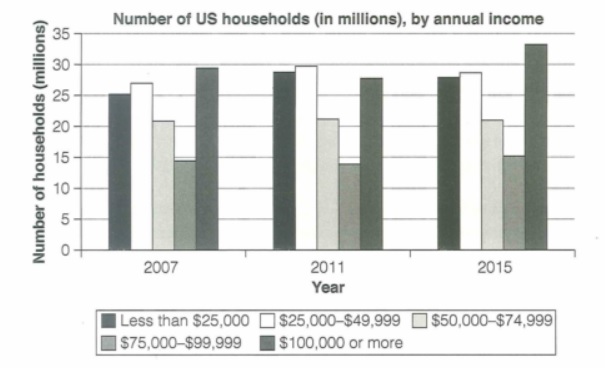
The chart below shows the number of households in the US by their annual income in 2007, 2011 and 2015.
Summarize the information by selecting and reporting the main features and make comparisons where relevant.
Student answer (Band 5.5)
The graph below highlights the number of households in the US by their annual earnings in 2007,2011 and 2015.
Households has been categorized into five different sections based on annual income.
The first category is of individuals earning less than 25,000. In 2007 around 25 million people used to earn less than 25,000, which increased to 28 million in 2015. People who used to earn between 25,000 and 49,999 increases from 27 million to around 30 million in 2011. Individuals who used to earn 50,000 and 74,999 in 2007 remains same in 2011 and 2015. Similarlly households which were generating 75,000 and 99,999 almost maintained its initial numbers.
The fifth category of people earning more than 100,000 shows a significant growth, in 2007 29 million of households were earning more than 100,000 which decreases to around 28 million in 2011 and with a major jump in 2011 it reaches to 33 million.
AI examiner evaluation
| Criterion | Band |
|---|---|
| Task Achievement / Task Response | 4.5 |
| Coherence and Cohesion | 5.5 |
| Lexical Resource | 5.5 |
| Grammatical Range and Accuracy | 5.5 |
| Overall | 5.5 |
Task Achievement / Task Response: Band 4.5
You identify the five income groups and report several relevant figures, including the rise in the $100,000-or-more group by 2015. However, the response lacks a clear overview of the chart’s main patterns, and some details are inaccurate or unclear: the highest-income group falls in 2011 before rising in 2015, not “with a major jump in 2011”; the $75,000–$99,999 group changes slightly rather than maintaining its initial number. The $50,000–$74,999 group is correctly described as stable. The response is also 142 words, below the required 150, which limits the development of the summary. Add a concise overview and report the key comparisons accurately.
Coherence and Cohesion: Band 5.5
The response has a basic sequence: it introduces the chart, moves through income categories, and gives the highest-income group a separate paragraph. This makes the information reasonably easy to follow. However, there is no distinct overview to guide the reader through the main trends, and the category-by-category listing does not build a strong overall progression. Linking is limited, with “The first category” and “The fifth category” doing much of the organisational work; “Similarly” does not clearly connect the two groups that follow it. Grouping categories by trend—for example, stable groups versus those that rise or fluctuate—and using clearer transitions would make the organisation more coherent and less list-like.
Lexical Resource: Band 5.5
You use a relevant range of chart vocabulary, including “categorized,” “increased,” “maintained,” “significant growth,” and “major jump,” so the topic is generally clear. However, some choices are imprecise or repetitive: “people” and “individuals” are used where the chart measures households, and “used to earn” is awkward for describing figures at particular dates. There are also spelling and form errors, such as “Similarlly” and “increases,” which reduce accuracy. Aim for precise terms such as “households” and “income group,” and use neutral reporting language like “stood at,” “rose to,” or “declined to.” This would improve precision and control without requiring unnecessarily complex vocabulary.
Grammatical Range and Accuracy: Band 5.5
You attempt both simple and longer sentence forms, and most of the intended comparisons can be understood. However, errors in agreement, tense, articles, and punctuation recur. For example, “Households has been categorized” should use a plural verb, while “Individuals … remains same” has a subject–verb agreement error and needs an article before “same.” The sentence beginning “The fifth category …” also joins several clauses with commas, making the sequence of changes harder to follow. Commas are missing in the opening date list, and some sentences shift between past and present forms. Check agreement and tense consistently, and divide long comparisons into complete sentences with appropriate punctuation.
See this exact question answered at other band scores. The same prompt compared across bands.
Browse more IELTS Writing model answers or get your own writing scored by the same AI examiner.