Band 4.5 IELTS Writing Task 1 Model Answer
Overall Band Score: 4.5 · Cambridge IELTS 18 · 2026-11-10
IELTS Writing Task 1 question
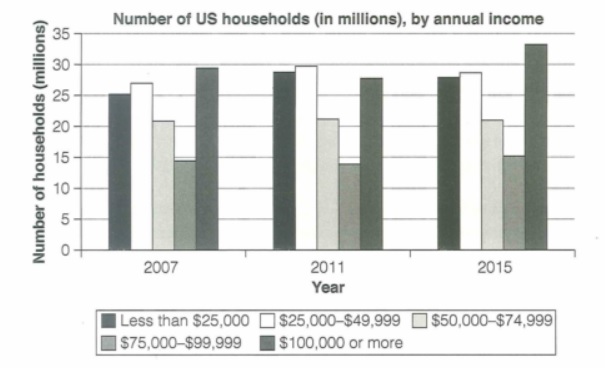
The chart below shows the number of households in the US by their annual income in 2007, 2011 and 2015.
Summarize the information by selecting and reporting the main features and make comparisons where relevant.
Student answer (Band 4.5)
in the shart below we see the number of households in us between 2007 to 2015 in comparition we see that the number of the households with price of [redacted phone]$ or more is mor than 32 than the households with less than 25000$ are 25 in 2007 but it started to change in 2011 it placed on 29 than 27 in 2015 the same think happend wth the [redacted phone]9$ in 2007 the number was 27 but on 2011 changed to 30 than in 2015 becamed to 29 on the price of [redacted phone]9$ the number of the households stated on 21 from 2007 to 2015 but in the price of [redacted phone]9$ the number in 2007 ws 14 in 2011 chngd to 13 but in 2015 chngd again to 15 finally we found that in 2015 the number of households was more than the other years
AI examiner evaluation
| Criterion | Band |
|---|---|
| Task Achievement / Task Response | 4.0 |
| Coherence and Cohesion | 4.5 |
| Lexical Resource | 4.5 |
| Grammatical Range and Accuracy | 4.5 |
| Overall | 4.5 |
Task Achievement / Task Response: Band 4.0
You identify several relevant figures and trends, including the stable $50,000–$74,999 group at about 21 million and the rise in the $100,000-or-more group by 2015. However, the response gives no clear, accurate overview of the main pattern: the highest-income group peaked in 2015, while the $75,000–$99,999 group remained the smallest. Some figures and trends are misreported; for example, the under-$25,000 group was about 28 million in 2015, not 27, and the $75,000–$99,999 group was about 14 million in 2011, not 13. The final claim that 2015 had more households than the other years is too broad. The response is also three words below the required minimum. Develop a concise overview and check comparisons against the chart.
Coherence and Cohesion: Band 4.5
The response follows a broadly chronological pattern, moving from 2007 to 2011 and then 2015, and words such as “but” and “finally” attempt to connect the information. However, it is presented as one long, run-on paragraph, so the reader has difficulty distinguishing an overview from the detailed comparisons. Several transitions are mechanical or unclear, particularly “it started to change in 2011 it placed on 29 than 27 in 2015.” The repeated sequence of income bands also makes the progression feel like a list rather than a grouped summary. Use separate paragraphs for the overview and details, and organise comparisons by similar trends—for example, rising, stable, and fluctuating categories.
Lexical Resource: Band 4.5
You use some task-relevant terms, including “number of households,” “price,” and “changed,” and the income ranges are generally identifiable. However, vocabulary is basic and repetitive, with “number” and “changed” used repeatedly instead of more precise reporting language. Several spelling errors—such as “shart,” “comparition,” “happend,” and “chngd”—make the response less clear and weaken the accuracy of key terms. “Price” is also not the right word for these categories; they are income bands. Build a small set of accurate chart-description expressions, such as “income bracket,” “stood at,” “rose to,” and “remained stable,” and check spelling before submitting.
Grammatical Range and Accuracy: Band 4.5
The response attempts to report changes across several years, but it relies mainly on simple clauses joined together, and sentence boundaries are often missing. For example, “in 2007 the number was 27 but on 2011 changed to 30 than in 2015 becamed to 29” lacks a clear subject in the later clauses and has faulty verb forms. There are also problems with articles, prepositions, and agreement, as in “the number of households was more than the other years.” These errors frequently make relationships between figures difficult to follow. Practise complete sentences with a clear subject and verb, and use consistent past-tense forms such as “rose,” “fell,” and “remained.” Add full stops to separate comparisons.
See this exact question answered at other band scores. The same prompt compared across bands.
Browse more IELTS Writing model answers or get your own writing scored by the same AI examiner.