Band 5.5 IELTS Writing Task 1 Model Answer
Overall Band Score: 5.5 · Cambridge IELTS 18 · 2026-11-12
IELTS Writing Task 1 question
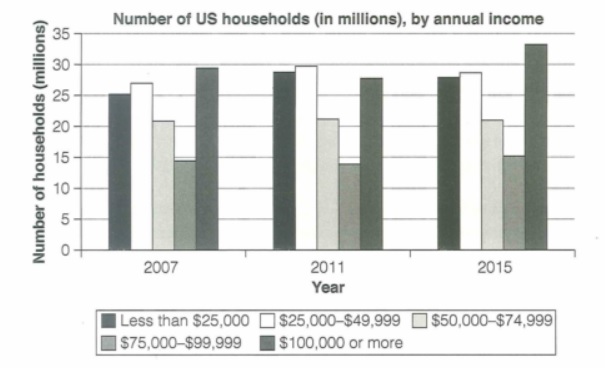
The chart below shows the number of households in the US by their annual income in 2007, 2011 and 2015.
Summarize the information by selecting and reporting the main features and make comparisons where relevant.
Student answer (Band 5.5)
The bar graph illustrates the yearly income of the US households in 2007, 2011, and 2015.
Overall, 2015 has more households who have income $100,000 and more. While, 2007 has less households for $75,000 - $99,999. In 2011, households who have income between $25000 - $49,999 are more than others.
Firstly, more people in US has income $100,000 and more with 29million in 2007. Moreover, income between $75,000 - $99,999 households are 14millions. Whereas, 25 million people has income less than $25,000 in 2007. However, more than 25million people has income between $25,000 - $49,999.
Secondly, in 2011 30 million of household in US has income between $25,000 - $49,999. Furthermore,28 million of people with less than $25,000 and 22 million of households has salary $50,000 - $74,000. Additionally, 33 million of people in 2015 has $100,000 or more income. Along that 28 million of households with less than $25,000. Finally, in 2011 only 13 million of people has income $75,000 - $99,999.
AI examiner evaluation
| Criterion | Band |
|---|---|
| Task Achievement / Task Response | 5.5 |
| Coherence and Cohesion | 5.0 |
| Lexical Resource | 5.5 |
| Grammatical Range and Accuracy | 5.5 |
| Overall | 5.5 |
Task Achievement / Task Response: Band 5.5
You identify several relevant features, including the high-income group’s rise by 2015 and the relatively low figure for the $75,000–$99,999 group. Some reported figures are broadly accurate, such as about 29 million in the highest-income group in 2007 and about 25 million below $25,000. However, the overview is incomplete and includes an inaccurate comparison: the $25,000–$49,999 group was not the largest in 2011; the $100,000-or-more group was slightly lower, while the $25,000–$49,999 group was about 29.5 million. The response also omits the stable middle-income group and does not clearly compare changes across all three years. Select the main trends more carefully and support them with accurate comparisons.
Coherence and Cohesion: Band 5.0
The response has a basic structure, with an introduction, an overview and two body paragraphs, and sequencing words such as “Firstly,” “Secondly” and “Finally” help signal movement through the data. However, the progression is not consistently logical: the second body paragraph shifts from 2011 figures to 2015 and then back to 2011, making the comparisons harder to follow. Some linking expressions are also awkward or overused, including “Moreover,” “Whereas” and “Along that,” and the overview’s “While” sentence is left as a fragment. Grouping information by income bands or comparing each year in a consistent order would create clearer progression and make the relationships between figures easier to understand.
Lexical Resource: Band 5.5
You use relevant task vocabulary, including “bar graph,” “households,” “income” and the income-band labels, so the topic remains understandable. However, the range is limited and several expressions are imprecise or unnatural for describing chart data. For example, “yearly income of the US households” suggests the chart shows income itself, rather than household counts by income category, and “more people in US has income” is an awkward way to describe the figures. Repetition of “more,” “households” and “income” also limits flexibility. Use precise reporting phrases such as “the number of households earning…” and verbs such as “rose,” “remained stable” and “stood at” to describe the data more naturally.
Grammatical Range and Accuracy: Band 5.5
You attempt both simple sentences and longer structures, including “While…” and “Moreover…” constructions, but control is inconsistent. Subject–verb agreement errors occur in phrases such as “more people in US has” and “25 million people has”; the plural subject requires “have,” or you can avoid the issue by writing “the figure was.” There are also problems with articles and sentence construction: “While, 2007 has…” is not a complete, well-formed contrast, and “Whereas” introduces a fragment. Plural forms and number expressions are also inconsistent, as in “14millions” and “30 million of household.” Build accurate complete sentences first, then use a wider range of comparisons and subordinate clauses with careful agreement and punctuation.
See this exact question answered at other band scores. The same prompt compared across bands.
Browse more IELTS Writing model answers or get your own writing scored by the same AI examiner.