Band 5.5 IELTS Writing Task 1 Model Answer
Overall Band Score: 5.5 · Cambridge IELTS 18 · 2026-11-13
IELTS Writing Task 1 question
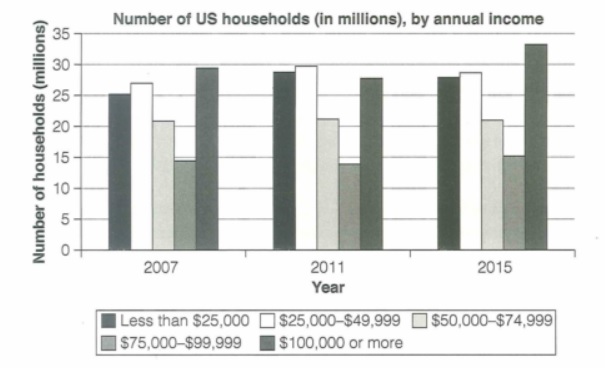
The chart below shows the number of households in the US by their annual income in 2007, 2011 and 2015.
Summarize the information by selecting and reporting the main features and make comparisons where relevant.
Student answer (Band 5.5)
The bar charts show the number of us households in million by their annual income in 2007, 2011 and 2015.
Overall, the number of households increased is most income group over the period. The highest growth was seen in the highest income group are S100,000 or more,
In the lowest income group of less then S25,000, the number of households rose from 25 million in 2007 to 29 million in 2011,before falling slightly to 27 million in 2015. similarly, households earning from S25,000 to S49,999 increase from around 27 millions.
For household earning S50.000 to S74,999,the stayad almost same around 20 to 21 millions all three years. The S75,000 to S99,999 the group showed little change. Staying between 16 to 14 millions.
AI examiner evaluation
| Criterion | Band |
|---|---|
| Task Achievement / Task Response | 5.0 |
| Coherence and Cohesion | 5.5 |
| Lexical Resource | 5.5 |
| Grammatical Range and Accuracy | 5.0 |
| Overall | 5.5 |
Task Achievement / Task Response: Band 5.0
You identify the chart’s subject and include an overview, noting that the highest-income group grew most. However, the overview is incomplete and partly inaccurate: not every income group increased, since the $50,000–$74,999 category stayed stable, while the $75,000–$99,999 group changed only slightly. Some figures are also misreported: the under-$25,000 group was about 28 million in 2015, not 27 million, and the $75,000–$99,999 figures were around 14–15 million, not 16–14 million. The account of the $25,000–$49,999 group is unfinished, and the largest category’s rise to about 33.5 million in 2015 is not described. The response is 113 words, below the 150-word minimum, which limits coverage and development.
Coherence and Cohesion: Band 5.5
The response has a basic structure: an introduction, an overview, and a paragraph describing income groups. This gives the reader some sense of how the information is organised. However, progression is limited because the final paragraph moves from one category to another without completing the comparisons; for example, the $25,000–$49,999 sentence stops after its starting figure. Linking is also inconsistent: “similarly” begins a sentence without a clear comparison, and “Staying between…” is a fragment rather than a connected statement. The overview is separated appropriately, but the body would be clearer if related trends were grouped and each category’s changes across all three years were reported in complete sentences.
Lexical Resource: Band 5.5
You use relevant chart vocabulary such as “number of households,” “income group,” “rose,” and “falling slightly,” so the topic is generally understandable. However, the range is limited and several word choices or forms are inaccurate, including “increased is most income group,” “less then,” “increase” for a past trend, and “stayad.” The repeated use of “group” and “number” also makes the description less precise. Use standard income-band labels consistently and choose verbs that clearly express the trend, such as “remained stable,” “climbed,” or “declined.” Careful spelling and collocation would make the comparisons easier to follow and more appropriate for an academic chart summary.
Grammatical Range and Accuracy: Band 5.0
The response attempts both simple statements and a more complex trend sentence, such as “rose from 25 million in 2007 to 29 million in 2011, before falling slightly.” This shows some ability to describe change over time. However, errors are frequent and sometimes make relationships unclear. For example, “the number of households increased is most income group” has faulty sentence structure, while “The $75,000 to $99,999 the group showed little change. Staying between…” is incomplete and fragmented. There are also problems with verb forms and agreement, as in “households … increase,” and punctuation is inconsistent, including missing spaces after commas. Practise complete subject–verb sentences and check past-tense forms and sentence boundaries.
See this exact question answered at other band scores. The same prompt compared across bands.
Browse more IELTS Writing model answers or get your own writing scored by the same AI examiner.