Band 5.5 IELTS Writing Task 1 Model Answer
Overall Band Score: 5.5 · Cambridge IELTS 18 · 2026-11-13
IELTS Writing Task 1 question
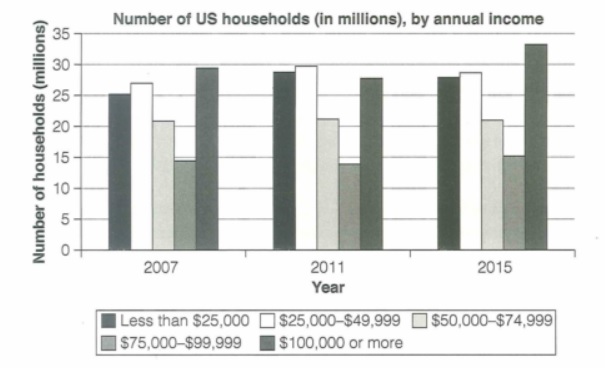
The chart below shows the number of households in the US by their annual income in 2007, 2011 and 2015.
Summarize the information by selecting and reporting the main features and make comparisons where relevant.
Student answer (Band 5.5)
The vertical bar chart illustrates the figure of househols in the United States by their yearly income in 2007, 2011 and 2015.
Overall, the income of households were greater in 2015 that is one lac or more than, while the lowest income were 75,000-99,999$ in 2015. In 2011,the large number of people earned about 25,000-49,999%, whereas small proportion of people's salary was 75,000-99,999$. In 2007, large figure of total population were earning 100,000 or more, while the smallest proportion' salary was 75,000-99,999$.
Taking the salaries; less than 25,000$, 25,000-49,999$ and 50,000-74,999$, large amount of individuals were taking 25,000-49,999% about 25 to 30 households in all three years, while less than 25,000$ salary were charging 28 households in 2007, 26 households in 2015 and 25 households in 2007. 50,000-74,999$ were earning approximately equally households in all three years which was 21 households.
Turning the last two figures of salaries, 75,000-99,999$ salary were charging approximately same number of people in three years, while 100,000$ or mre salary were charged 35 households more in 2015
AI examiner evaluation
| Criterion | Band |
|---|---|
| Task Achievement / Task Response | 5.0 |
| Coherence and Cohesion | 6.0 |
| Lexical Resource | 5.0 |
| Grammatical Range and Accuracy | 5.0 |
| Overall | 5.5 |
Task Achievement / Task Response: Band 5.0
You identify the chart’s subject and make comparisons across the three years, including the stable figure of about 21 million households in the $50,000–$74,999 group. However, the overview is unclear and includes inaccurate claims: the $75,000–$99,999 group was the smallest in 2007 and 2011, but not in 2015, when the under-$25,000 group was slightly lower. Several figures are also misreported or confused—for example, the under-$25,000 category is given as 28, 26 and 25, rather than about 25, 28.5 and 28 million, and the final figure of 35 million is too high. Select the main trends accurately and support them with a few reliable comparisons.
Coherence and Cohesion: Band 6.0
The response has a recognisable structure: an introduction, an overview, and two paragraphs grouping income categories. This makes the information broadly easy to follow, and transitions such as “Turning the last two figures” signal a change in focus. However, progression is weakened by repetition of the same “large” and “smallest” comparisons in the overview and body, and some references are unclear, such as “the last two figures of salaries.” The long sentence beginning “Taking the salaries” combines several categories and comparisons, making the sequence difficult to track. Use clearer topic sentences and organise each paragraph around a distinct trend, with accurate category labels repeated where needed.
Lexical Resource: Band 5.0
You use some task-related vocabulary, including “vertical bar chart,” “approximately,” “proportion,” and “households,” so the reader can identify the topic. However, the range is limited and several word choices or collocations make the meaning awkward: “the income of households were greater,” “salary were charging,” and “large figure of total population” do not describe household counts naturally. There are also spelling and notation problems, including “househols,” “mre,” and using “%” after income ranges, where dollar signs are required. Prefer precise chart language such as “the number of households,” “stood at,” and “income bracket,” and check spelling and currency formatting.
Grammatical Range and Accuracy: Band 5.0
You attempt both simple and more extended sentences, using structures such as “while” to compare categories. However, errors in agreement, tense, and sentence construction are frequent enough to make some statements difficult to interpret. For example, “the income of households were greater” has a subject–verb agreement problem, while “the lowest income were” also mismatches singular and plural forms. The sentence beginning “Taking the salaries” has an unclear structure, and the final sentence lacks a clear ending and comparison. Practise building accurate sentences with “the number of households in [bracket] was…” and use consistent past-tense reporting, checking that each sentence has a clear subject and verb.
See this exact question answered at other band scores. The same prompt compared across bands.
Browse more IELTS Writing model answers or get your own writing scored by the same AI examiner.