Band 6.0 IELTS Writing Task 1 Model Answer
Overall Band Score: 6.0 · Cambridge IELTS 18 · 2026-11-18
IELTS Writing Task 1 question
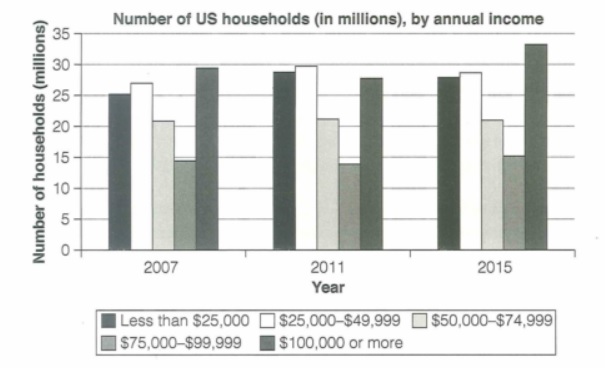
The chart below shows the number of households in the US by their annual income in 2007, 2011 and 2015.
Summarize the information by selecting and reporting the main features and make comparisons where relevant.
Student answer (Band 6.0)
The bar chart gives information about the count of American families by their annual earnings in three different years. Units are measured in millions.
Overall, the US households annual income increased. People earning [redacted phone] dollars or more represent the largest category, while people earning between 50.000 and 74.999 dollars are the smallest category.
The number of families earning less than 25.000 stood at 25 million families in 2007 and then increased in 2011 to reach around 28, before witnessing a slight decrease 2015. Households earning between 25.000 and 49,999 were more than 26 million before reaching almost 30 million in 2011, when they was the largest category.
The number of families that earn between 50.000 and 74.999 remained stable among the three years at around 21 million family and those who earn between 75.000 and 99.999 fluctuated between 14 and 15 million. Household with high income([redacted phone] or more) were just under 30 million in 2007then witnessed a decrease in 2011. In 2015, this category peaked at aound 33 million, which is the highest number.
AI examiner evaluation
| Criterion | Band |
|---|---|
| Task Achievement / Task Response | 6.0 |
| Coherence and Cohesion | 6.0 |
| Lexical Resource | 6.0 |
| Grammatical Range and Accuracy | 5.5 |
| Overall | 6.0 |
Task Achievement / Task Response: Band 6.0
You cover all five income groups and provide a clear overview, identifying the $100,000-or-more group as the largest overall and the $50,000–$74,999 group as stable. Several figures and trends are accurately reported, including the steady 21 million for the middle group and the high-income category’s rise to about 33 million in 2015. However, the overview says household income “increased,” which is too broad: the chart shows household counts within income bands, and several categories were stable or fluctuated. Some comparisons are also incomplete; for example, the $25,000–$49,999 group was not the largest in 2011, since the under-$25,000-or-more group was close and the chart’s highest figure was the high-income group in 2007. Make the overview more precise and compare the key highs and changes directly.
Coherence and Cohesion: Band 6.0
The response has a recognisable structure: an introduction, an overview, and two paragraphs describing the income bands. This makes the information generally easy to follow, and time markers such as “in 2007,” “in 2011,” and “In 2015” help establish chronology. However, the grouping of details is not fully consistent: the first body paragraph discusses two lower-income bands, while the second combines the remaining three, and the comparisons between categories are limited. Some linking phrases, such as “before reaching” and “when,” make the sequence of changes less clear than it could be. Organise the body paragraphs by meaningful groups or trends, and use clearer comparisons to show how categories relate to one another.
Lexical Resource: Band 6.0
You use an adequate range of task-related vocabulary, including “remained stable,” “fluctuated,” “slight decrease,” and “peaked,” which helps describe changes rather than simply list figures. The income bands are also identified clearly. Some word choices and collocations are less natural or precise, however: “count of American families” and “people earning” do not consistently match the chart’s measure of households, while “the US households annual income increased” misrepresents what the data show. There are also presentation errors in figures, such as writing “100.000” instead of “100,000,” and the typo “aound.” Use consistent terms such as “households” and “number of households,” and check number formatting and spelling.
Grammatical Range and Accuracy: Band 5.5
You attempt a mix of simple and more complex sentence forms, and most of the meaning remains understandable. There are some errors in agreement, tense, articles, and sentence construction. For example, “when they was the largest category” has incorrect subject–verb agreement, and “around 21 million family” needs a plural noun. The phrase “Household with high income … were” also has a singular–plural mismatch, while “before witnessing a slight decrease 2015” is missing a preposition. Punctuation and spacing are inconsistent in “2007then,” and the final sentence would be clearer with a complete, well-punctuated structure. Review agreement and plural forms, and proofread each sentence for missing small grammatical words.
See this exact question answered at other band scores. The same prompt compared across bands.
Browse more IELTS Writing model answers or get your own writing scored by the same AI examiner.