Band 5.5 IELTS Writing Task 1 Model Answer
Overall Band Score: 5.5 · Cambridge IELTS 18 · 2026-11-22
IELTS Writing Task 1 question
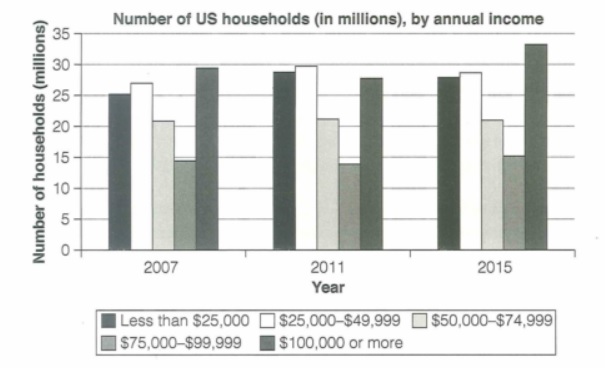
The chart below shows the number of households in the US by their annual income in 2007, 2011 and 2015.
Summarize the information by selecting and reporting the main features and make comparisons where relevant.
Student answer (Band 5.5)
The given chart compares the number of households in three different years in five categories of annual income.The number of households in the first category which is less than $25,000 was significantly high in 2011 and its lowest was in 2007. The second category of annual income between $25,000 and $49,999 it was similar to the previouse one, the highest was in 2011 and the lowest was in 2007. It's noticeable that the annual income between $50,000 and $74,999 was constant in the three given years. The follwoing category which is between $75,000 and $99,999 had the lowest number of households in all of the categories and it reached its highes number in 2015. On the other hand the last category which was of annual income $100,000 or more was the highest most of the given years and reached the highest number of households in 2015 reporting more than 30 households of that income.
AI examiner evaluation
| Criterion | Band |
|---|---|
| Task Achievement / Task Response | 5.0 |
| Coherence and Cohesion | 5.5 |
| Lexical Resource | 5.5 |
| Grammatical Range and Accuracy | 5.5 |
| Overall | 5.5 |
Task Achievement / Task Response: Band 5.0
You identify the five income groups and report several relevant patterns, including the stability of the $50,000–$74,999 group and the 2015 peak for households earning at least $100,000. However, the response only partially summarises the chart: it gives no clear overall overview bringing the main trends together, and most categories are described without figures or meaningful comparisons. Some claims are also imprecise. For example, the $100,000-or-more group was not the largest in most years: it was largest in 2007 and 2015, but the $25,000–$49,999 group was largest in 2011. “More than 30 households” should also be expressed as more than 30 million. Select the key contrasts and support them with accurate approximate values.
Coherence and Cohesion: Band 5.5
The response follows a generally understandable order, moving through the income categories, and phrases such as “On the other hand” signal a contrast. However, it reads largely as one continuous paragraph, with no distinct overview to guide the reader from the main picture to the details. The repeated pattern of introducing each category and stating its high or low point also limits progression and makes the account feel list-like. Some references are unclear, such as “the highest most of the given years,” which does not specify which years or comparison is intended. Organise the response into an introduction, an overview, and grouped detail paragraphs, and use linking expressions to show comparisons between categories rather than simply moving from one to the next.
Lexical Resource: Band 5.5
You use relevant chart vocabulary, including “category,” “constant,” “reached,” and “number of households,” so the topic is generally clear. However, the range is limited and several expressions are awkward or imprecise. “Significantly high” does not clearly describe a change or a comparison, while “the highest most of the given years” is difficult to interpret. The phrase “more than 30 households” also omits the chart’s unit, millions. Spelling errors such as “previouse,” “follwoing,” and “highes” are noticeable and reduce accuracy. Aim for precise reporting language such as “rose to,” “remained stable,” and “was the largest category,” and check spelling and units carefully.
Grammatical Range and Accuracy: Band 5.5
The response includes some attempts at complex sentences, for example, “The following category which is between $75,000 and $99,999 had the lowest number of households in all of the categories and it reached its highest number in 2015.” Most meanings remain understandable, but sentence control is uneven. The opening has a missing space after the full stop, and the second category sentence is a fragment-like construction: “The second category … it was similar to the previous one.” The repeated use of “was” and “which is” also limits the range of structures and makes the time references less controlled when describing past data. Use complete, clearly structured sentences and consistent past-tense reporting, for example, “The $25,000–$49,999 group rose to its peak in 2011.”
See this exact question answered at other band scores. The same prompt compared across bands.
Browse more IELTS Writing model answers or get your own writing scored by the same AI examiner.