Band 5.5 IELTS Writing Task 1 Model Answer
Overall Band Score: 5.5 · Cambridge IELTS 18 · 2026-11-24
IELTS Writing Task 1 question
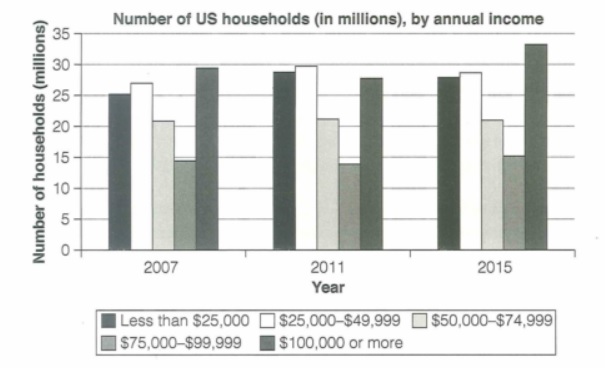
The chart below shows the number of households in the US by their annual income in 2007, 2011 and 2015.
Summarize the information by selecting and reporting the main features and make comparisons where relevant.
Student answer (Band 5.5)
This line graph illustrates the data of different level of annual wages of families in the United States in 2007, 2011 and 2015.
As we can see, the number of famil;\ies whose annual income was less than $25000, it began with around 25 million in 2007, then increased approximately 29 million in 2011, after four years the number losses about 2 million and reached 27 million by 2015.Those families that earned more than $25000 were about 26 million in 2007, by the time in 2015 the number ended around 29 million families.
In comparison, the group of families have high income, including $75000 to $90000 and $[redacted phone] or more, experienced a drop in 2011, but in 2015 the data increased.
Interesting thing is the data of middle income ($50000 to $74999) group were same by throughout the period.
AI examiner evaluation
| Criterion | Band |
|---|---|
| Task Achievement / Task Response | 4.5 |
| Coherence and Cohesion | 5.5 |
| Lexical Resource | 5.5 |
| Grammatical Range and Accuracy | 5.5 |
| Overall | 5.5 |
Task Achievement / Task Response: Band 4.5
You identify several relevant categories and report the broadly stable middle-income group, but the response gives only a partial account of the chart. The opening calls it a “line graph,” and the overview is missing: the key comparison is that households earning $100,000 or more rose to the highest figure in 2015, while the $50,000–$74,999 group stayed level. Some figures and trends are inaccurate: the under-$25,000 group ended at about 28 million, not 27 million, and the $75,000–$99,999 group did not rise after a 2011 drop in the same way as the highest-income group. The statement about everyone earning over $25,000 combines four distinct bands and obscures their different patterns. The response is also 12 words below the required minimum. Add a clear overview and select accurate comparisons across the bands.
Coherence and Cohesion: Band 5.5
The response has a basic paragraph structure: an introduction is followed by descriptions of lower-income households, higher-income groups, and the stable middle band. Connectors such as “In comparison” and “Interesting thing” show an attempt to guide the reader. However, the progression is not fully clear because several income categories are grouped together, and the broad statement about families earning more than $25,000 does not lead into a precise comparison. The overview is also absent, so the main message is not established before the details. Some linking is awkward, particularly “by the time in 2015.” Organise the body by meaningful trends, use clear references to each income band, and make the overview the second paragraph.
Lexical Resource: Band 5.5
You use some task-relevant vocabulary, including “annual income,” “increased,” “drop,” and “throughout the period,” and the reader can generally understand the categories being discussed. However, the range is limited and several choices are inaccurate or unnatural: “different level of annual wages” is not a suitable description of income bands, and “the number losses” uses the wrong word form and collocation. “Data” is also repeated where “number of households” would be more precise. There is a spelling/typing error in “famil;ies,” and the chart is called a “line graph” rather than a bar chart. Aim for precise terms such as “income bracket,” “households,” and “rose/fell to,” and check spelling and collocations.
Grammatical Range and Accuracy: Band 5.5
You attempt both simple and more extended sentences, for example the sentence beginning “As we can see” and the clause “whose annual income was less than $25000.” Some relationships between time and change are communicated, but control is inconsistent. In “it began with around 25 million … then increased,” the subject is unclear; “the number of households” would make the reference precise. The sequence “after four years the number losses … and reached” has faulty tense and sentence construction, while “the group of families have high income … experienced” has an agreement problem. Missing spaces after full stops and the comma after “In comparison” also affect punctuation. Use past-tense verbs consistently and divide long sequences into complete, clearly punctuated sentences.
See this exact question answered at other band scores. The same prompt compared across bands.
Browse more IELTS Writing model answers or get your own writing scored by the same AI examiner.