Band 5.5 IELTS Writing Task 1 Model Answer
Overall Band Score: 5.5 · Cambridge IELTS 18 · 2026-11-25
IELTS Writing Task 1 question
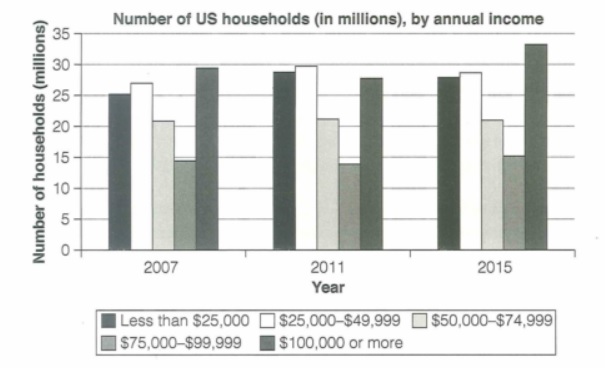
The chart below shows the number of households in the US by their annual income in 2007, 2011 and 2015.
Summarize the information by selecting and reporting the main features and make comparisons where relevant.
Student answer (Band 5.5)
The bar chart illustartes the number of households in the US according to their yearly income in 2007, 2011, and 2015.
Overall, we can see that as Number of households increases as their annual income also gets increases and both are represented in millions.
In the year 2007 and 2011 annual income less than ($25,000) containing households are 25 millions and 29 millions respectively in addition yearly income ($25,000-$49,000) having households are 27 millions and 30 millions. whereas, households containing income ($50,000-$74,999) are remained same at 21 millions and both income more than ($75,000 and $100,000 or more) are at 14 and at 29 in 2007 and at 14 and 28 in 2011.
In the year 2015, annual income less than ($25,000) and between ($25,000-$49,000) containing households are at 28 and 29 millions respectively and income between ($50,000-$74,999) and ($75,000-$99,000) containing households are at 21 and 15 millions respectively. While, households having yearly income more than ($100,000) at 33 millions.
AI examiner evaluation
| Criterion | Band |
|---|---|
| Task Achievement / Task Response | 5.0 |
| Coherence and Cohesion | 5.5 |
| Lexical Resource | 5.5 |
| Grammatical Range and Accuracy | 5.0 |
| Overall | 5.5 |
Task Achievement / Task Response: Band 5.0
You identify the chart’s subject and report several relevant figures, including the stable 21 million in the $50,000–$74,999 group and the rise in households earning at least $100,000 by 2015. However, the overview is unclear and does not accurately summarise the main pattern: “as Number of households increases as their annual income also gets increases” suggests a general relationship that the chart does not show. Some figures or categories are also imprecise: the $75,000–$99,999 group is about 14.5, 14 and 15 million, not simply 14 in both earlier years, and the 2015 $25,000–$49,999 figure is about 28.5 million. Make the overview explicit and compare the main rises, falls and stable groups.
Coherence and Cohesion: Band 5.5
The response has a basic, useful structure: an introduction, an overview, and paragraphs covering 2007–2011 and 2015. This gives the reader some organisation, and time markers such as “In the year 2015” help signal a shift. However, progression within the data paragraphs is difficult to follow because several categories and years are packed into long sentences. Connectors such as “whereas,” “in addition,” and “while” are not always used to show a clear relationship, and the overview does not guide the comparisons that follow. Grouping the income bands into clear comparisons—for example, the two lower bands, the stable middle band, and the highest band—would make the information easier to track.
Lexical Resource: Band 5.5
You use relevant chart vocabulary, including “households,” “annual income,” “respectively,” and “millions,” so the topic is generally clear. However, the range is limited and some repeated or awkward phrases make the report less precise, particularly “containing households” and “having households.” There are also spelling and form errors, such as “illustartes,” and the income labels are not consistently expressed: “$25,000-$49,000” does not match the chart’s upper limit of $49,999. Choose concise reporting language and reproduce category labels accurately. More precise verbs such as “stood at,” “remained stable,” and “rose to” would help you describe the figures without repeatedly using “are at” or “containing.”
Grammatical Range and Accuracy: Band 5.0
You attempt both simple and more complex sentences, including comparisons across years, but control is uneven. Several sentences contain faulty structures, such as “as Number of households increases as their annual income also gets increases,” where the repeated “as” construction and verb forms obscure the meaning. In “households containing income … are remained same,” the passive form is incorrect, and “both income more than … are at” has unclear agreement and sentence structure. Capitalisation and punctuation also need attention, especially the lower-case “whereas” after a full stop and the comma before “While.” Use straightforward, complete sentences first, then add controlled comparisons with accurate verb forms and agreement.
See this exact question answered at other band scores. The same prompt compared across bands.
Browse more IELTS Writing model answers or get your own writing scored by the same AI examiner.