Band 5.0 IELTS Writing Task 1 Model Answer
Overall Band Score: 5.0 · Cambridge IELTS 18 · 2026-11-25
IELTS Writing Task 1 question
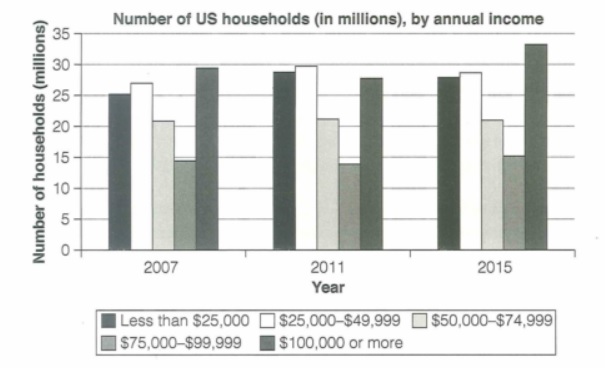
The chart below shows the number of households in the US by their annual income in 2007, 2011 and 2015.
Summarize the information by selecting and reporting the main features and make comparisons where relevant.
Student answer (Band 5.0)
The given bar chart shows the number of US households by their yearly income in 2007, 2011 and 2015.
Overall, it can be seen that the highest number of households for those earned 100,000 or more yearly in 2015, while the lowest number of households who take 75,000$-99,999$ in 2011 and 2015.
In 2007, around 29 millions of family members earned [redacted phone]$ or more in a year. while 25 millions and 27 millions take approximately less than 25,000$ and 25,000$-49,999$ respectively. However, the income for 22% of families was 50,000$-74,999$. Finally, the lowest amount for 17 millions was 75,000$-99,999$
AI examiner evaluation
| Criterion | Band |
|---|---|
| Task Achievement / Task Response | 4.0 |
| Coherence and Cohesion | 5.0 |
| Lexical Resource | 5.0 |
| Grammatical Range and Accuracy | 5.0 |
| Overall | 5.0 |
Task Achievement / Task Response: Band 4.0
You identify the chart’s subject and give an overview, correctly noting that the $100,000-or-more group is highest in 2015. However, the response covers only 2007 in detail and omits the key changes in 2011 and 2015, so the main comparisons are largely missing. Some figures are also inaccurate: the $50,000–$74,999 group is about 21 million, not “22%,” and the $75,000–$99,999 group is about 14–15 million, not 17 million. The overview’s claim that this latter group is lowest in 2011 and 2015 is not correct; it is the smallest in 2015, while the $75,000–$99,999 group is also the smallest in 2011. The response is 99 words, below the required 150. Include a fuller account of all three years and accurate units.
Coherence and Cohesion: Band 5.0
The response has a basic structure: an introduction, an overview, and a paragraph of figures for 2007. This gives the reader some sense of organisation, and transitions such as “Overall,” “However,” and “Finally” help signal relationships. However, there is no clear progression through the three years: the body stops after 2007, leaving the later data unreported. The sequence of figures within the body is also somewhat abrupt, and “while” after a full stop does not connect smoothly to the preceding sentence. To improve, group information by meaningful comparisons—for example, describe the 2007 baseline, then explain what changed by 2011 and 2015—and use linking expressions only where they clarify those relationships.
Lexical Resource: Band 5.0
You use relevant basic terms such as “bar chart,” “number of households,” “yearly income,” and “approximately,” so the topic is generally understandable. However, the vocabulary range is limited and some choices are inaccurate or unnatural for describing statistical data. “Family members” refers to people rather than households, “take” does not describe an income category, and “the income for 22% of families” confuses a percentage with a number of households. Currency formatting is also inconsistent (“100.000$” and “75,000$-99,999$”). Use precise terms such as “households,” “income bracket,” and “stood at,” and keep the units consistent in millions. This would make the comparisons clearer and more appropriate to an academic chart summary.
Grammatical Range and Accuracy: Band 5.0
You attempt a few sentence forms, including a relative clause in “those earned 100,000 or more” and a contrast introduced by “while.” However, the range remains limited, and errors recur in sentence construction, agreement, and punctuation. For example, “the highest number of households for those earned” is not a well-formed clause; “the highest number of households was in the group earning…” would be clearer. “The lowest number of households who take…” uses an unsuitable relative pronoun and verb form, while “29 millions” and “25 millions” have incorrect plural forms. The sentence beginning “while 25 millions…” is also incorrectly separated by a full stop. Practise accurate comparative sentences and check clause structure, singular/plural forms, and sentence boundaries.
See this exact question answered at other band scores. The same prompt compared across bands.
Browse more IELTS Writing model answers or get your own writing scored by the same AI examiner.