Band 6.0 IELTS Writing Task 1 Model Answer
Overall Band Score: 6.0 · Cambridge IELTS 18 · 2026-11-27
IELTS Writing Task 1 question
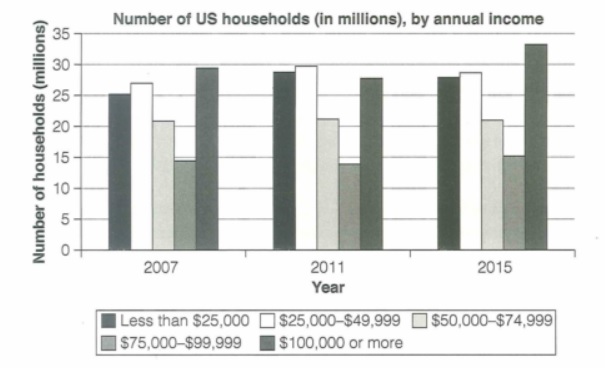
The chart below shows the number of households in the US by their annual income in 2007, 2011 and 2015.
Summarize the information by selecting and reporting the main features and make comparisons where relevant.
Student answer (Band 6.0)
The bar graph compares the number of households in US according to their annual income in three years, 2007, 2011, 2015.
Overall, it can be seen that the people earning more than 100k annualy were significant in all the three years, while those who earns between 75k and 99k were the lowest. The others annual earning groups fluctuated only a little.
In 2007, about 30 million household generated more than 100k which decreased to around 27 million people in 2011 and rose significantly in the next year to 33 million people. The individuals earning between 75k and 99k were nearly 15 million people in all the three years.
25 million people earned less than 25k in 2007 which inclined to approximately 29 and then declined to 27 million in 2011 and 2015 respectively. Not more than 30 million household earned between 25k and 49k . Lastly, the houses who earned 50k to 74k remained stable throughout the period and they were around 21 million.
AI examiner evaluation
| Criterion | Band |
|---|---|
| Task Achievement / Task Response | 6.0 |
| Coherence and Cohesion | 6.0 |
| Lexical Resource | 5.5 |
| Grammatical Range and Accuracy | 5.5 |
| Overall | 6.0 |
Task Achievement / Task Response: Band 6.0
You identify the main pattern that the $100,000-or-more group was among the largest and that the $75,000–$99,999 group was the smallest, and you include relevant figures for several categories. However, the overview is not fully accurate: the highest-income group was not the largest in every year, since the $25,000–$49,999 group was slightly higher in 2011. There is also a factual inconsistency in the account of households earning under $25,000: the text says this figure rose to about 29 million, then fell to 27 million, whereas the chart shows about 28.5 million in 2011 and 28 million in 2015. The $25,000–$49,999 category is described only vaguely. More precise comparisons and a corrected overview would make the key features clearer.
Coherence and Cohesion: Band 6.0
The response has a clear overall structure: an introduction, an overview, and two paragraphs reporting details. The information is generally grouped by income categories, and transitions such as “Overall,” “In 2007,” and “Lastly” help the reader follow the account. However, some connections are mechanical, and the final paragraph moves between categories without a particularly clear comparison. The sentence beginning “25 million people earned less than 25k” also gives a confusing sequence of years, making the trend harder to follow. Use explicit year references for each change and organise the details into clearer comparisons—for example, grouping the two lower-income categories together and then contrasting them with the higher-income groups.
Lexical Resource: Band 5.5
You use relevant chart vocabulary, including “compares,” “decreased,” “rose,” “remained stable,” and “fluctuated,” so the main trends are usually understandable. However, several choices are imprecise or unnatural for describing household data. “People” and “individuals” are repeatedly used where the chart counts households, and “houses who earned” is an unsuitable expression. “Annualy” is misspelled, while “inclined” does not naturally describe an increase in a figure. The repeated shorthand “100k,” “75k,” and “25k” is also less formal than the chart’s income bands. Aim for accurate collocations and consistent terms such as “households earning” and “the number rose.”
Grammatical Range and Accuracy: Band 5.5
You attempt a mix of simple and more complex forms, including a relative clause in “those who earns between 75k and 99k” and a contrastive structure in “which decreased … and rose.” Most of the intended meaning remains understandable, but some grammatical errors recur. Subject–verb agreement is incorrect in “those who earns,” and singular/plural forms are inconsistent in “30 million household.” The opening phrase “in US” is missing an article, and the sentence about the under-$25,000 group has unclear tense and sequencing. There are also punctuation and spacing issues, such as the missing full stop before “Lastly.” Check agreement, articles, and plural nouns, and use complete sentences with clear year references.
See this exact question answered at other band scores. The same prompt compared across bands.
Browse more IELTS Writing model answers or get your own writing scored by the same AI examiner.