Band 5.0 IELTS Writing Task 1 Model Answer
Overall Band Score: 5.0 · Cambridge IELTS 18 · 2026-11-28
IELTS Writing Task 1 question
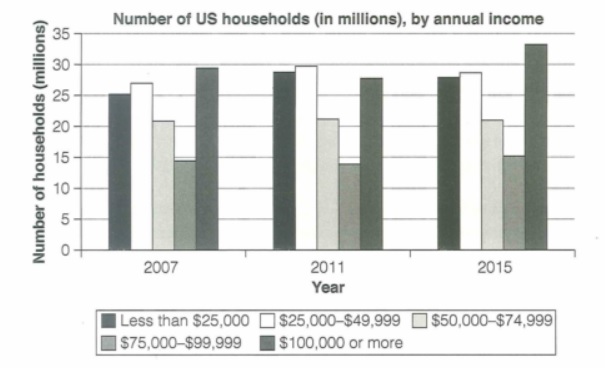
The chart below shows the number of households in the US by their annual income in 2007, 2011 and 2015.
Summarize the information by selecting and reporting the main features and make comparisons where relevant.
Student answer (Band 5.0)
The chart Shows the number of households in the US by their annual income in 2007, 2011 and 2015.
In 2007, Lowest figure was recorded in the range of $75000-$99999 annual income housholders. The highest figure was recorded in the range of $[redacted phone] or more annual income househoders.
In 2011, The range of $75000-$99999 annual income householders were lowest income householders however $25000-$49999 income holders were got highest figure.
In 2015 , The lowest figure was recorded in the range of $75000-$99999. The highest figure was recorded in the range of $[redacted phone] more annual income householders.
Overall, compared with these three years, The highest annual income holders were in 2015 That was the range of $[redacted phone] or more however the loweset annual income holders were in 2011. That was the range of $75000-$99999.
Overall these three years the lowest figure was recorded in the similar range that was $75000-$99999. While In 2007 and 2015 the highest figure was recorded in the same range of $[redacted phone] or more.
AI examiner evaluation
| Criterion | Band |
|---|---|
| Task Achievement / Task Response | 5.0 |
| Coherence and Cohesion | 5.0 |
| Lexical Resource | 5.0 |
| Grammatical Range and Accuracy | 5.0 |
| Overall | 5.0 |
Task Achievement / Task Response: Band 5.0
You identify the lowest and highest income groups for each year, and your statements that the $75,000–$99,999 group was consistently the smallest and the $100,000-or-more group was largest in 2007 and 2015 are supported by the chart. However, the account is only partial: it gives almost no figures and misses important comparisons, especially the rise of the highest-income group to about 33.5 million in 2015 and the broadly stable middle-income groups. The claim that the lowest annual-income holders were in 2011 is also unclear and conflicts with your earlier identification of the lowest household count. A clearer overview and selected numerical evidence would make the main trends more fully developed.
Coherence and Cohesion: Band 5.0
The response has some organisation: it moves through 2007, 2011 and 2015, then attempts an overall summary. This gives the reader a basic framework. However, progression is limited because the year-by-year statements repeat the same highest/lowest information, and the two paragraphs beginning “Overall” largely restate one another. Linking words such as “however” and “while” are used, but the relationships they signal are not always clear; for example, the contrast in “the highest annual income holders … however the lowest annual income holders” is difficult to interpret. Grouping the main trends together and using clearer references would create a more logical comparison.
Lexical Resource: Band 5.0
You use relevant terms such as “highest figure,” “lowest figure,” “range” and “annual income,” so the topic is generally understandable. However, the vocabulary is narrow and repetitive, with “figure” and “range” doing much of the work instead of more precise language for describing changes and household totals. Several word-choice and spelling problems reduce clarity, including “househoders,” “househoders”/“householders” used for households, “loweset,” and “income holders.” Some expressions, such as “highest annual income holders,” do not clearly describe the number of households in an income bracket. Use accurate chart vocabulary and check spelling and collocations carefully.
Grammatical Range and Accuracy: Band 5.0
Most sentences are simple statements, and the repeated pattern “The highest figure was recorded…” shows an attempt to report comparisons. There is also an attempt to combine ideas with “however” and “while.” However, the range of sentence structures is limited, and errors are frequent enough to make some relationships unclear. For example, “householders were lowest income householders” lacks a clear grammatical structure, while “income holders were got highest figure” has faulty verb construction. Capitalisation after commas and sentence openings is inconsistent, and punctuation around year references is uneven. Practise accurate comparative sentences and check subject–verb structure, articles and punctuation.
See this exact question answered at other band scores. The same prompt compared across bands.
Browse more IELTS Writing model answers or get your own writing scored by the same AI examiner.