Band 5.0 IELTS Writing Task 1 Model Answer
Overall Band Score: 5.0 · Cambridge IELTS 18 · 2026-11-28
IELTS Writing Task 1 question
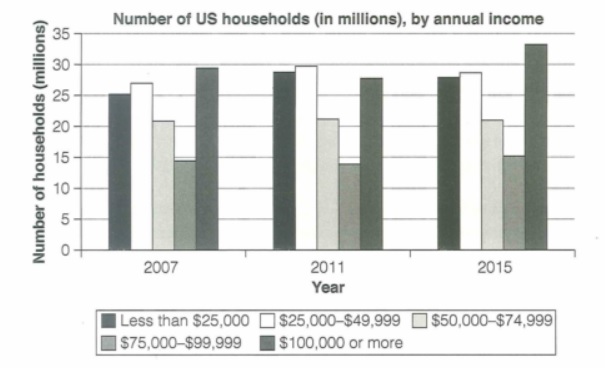
The chart below shows the number of households in the US by their annual income in 2007, 2011 and 2015.
Summarize the information by selecting and reporting the main features and make comparisons where relevant.
Student answer (Band 5.0)
The bar graph shows the number of households in the US by their annual income in different years.Different number of households have different number of annual incomes. The households are expressed in millions and dollar is used as the currency for income.
Approximately, 20 million households with annual income of 50,000 to 74,999 dollars are observed and this number reamin constant in the given years. The number of households with annual income of 75,000 to 99,999 dollars are observed fluctuating around the 15 million throughout the years.
Households with the annual income of less then 25000 dollars almost remain same between 25 to 30 million that shows that a big part of population of US belongs to the low income category and US is also a region with poverty.
A rise is observed in the number of households with annual income of 100,000 dollars or more.
AI examiner evaluation
| Criterion | Band |
|---|---|
| Task Achievement / Task Response | 4.5 |
| Coherence and Cohesion | 5.0 |
| Lexical Resource | 5.5 |
| Grammatical Range and Accuracy | 5.5 |
| Overall | 5.0 |
Task Achievement / Task Response: Band 4.5
The response identifies several relevant categories and reports that the $50,000–$74,999 group stayed around 20 million and the $75,000–$99,999 group remained near 15 million. However, it only partially summarises the chart: the key comparison that households earning $100,000 or more rose sharply to the highest figure in 2015 is not developed, and the $25,000–$49,999 category is omitted. The claim that the low-income figures show that the US “is also a region with poverty” is an unsupported interpretation rather than a chart-based feature. The response is also below the required 150 words, which limits the detail and coverage. To improve, give a clear overview of the main changes and compare the categories with selected figures.
Coherence and Cohesion: Band 5.0
The response has a basic paragraph structure, moving from an introduction to descriptions of several income groups, and the categories are generally presented in a sensible order. However, there is no clear overall progression towards a complete summary: the final sentence introduces the rise in the highest-income group but gives no figures or comparison, while another category is left out. Linking is limited, and phrases such as “Different number of households have different number of annual incomes” repeat the introduction without advancing the report. Organise the body around the main patterns—for example, stable middle-income groups versus changing lower- and higher-income groups—and use clear comparisons to connect the details.
Lexical Resource: Band 5.5
The response uses relevant chart vocabulary, including “households,” “annual income,” “fluctuating,” and “rise,” so the reader can identify the subject and some trends. However, the range is limited and several expressions are imprecise or unnatural, such as “different number of annual incomes” and “a big part of population.” “Region with poverty” is also an unsuitable interpretation of the data rather than a precise description of the chart. Spelling errors such as “reamin” and “less then” reduce accuracy. Aim for concise, conventional reporting language and use terms such as “income bracket,” “remained stable,” and “accounted for” to describe the figures more precisely.
Grammatical Range and Accuracy: Band 5.5
The response includes some simple and more extended sentence forms, such as “Approximately, 20 million households … are observed and this number…” and “that shows that…”. Meaning is generally understandable, but grammatical control is uneven. For example, “Different number of households have different number” has number-agreement and plural problems, while “The number … dollars are observed” uses a singular subject with a plural verb. The sentence beginning “Households with the annual income…” also has an awkward clause structure, and punctuation is missing after “years” in the opening. Use direct subject–verb constructions, check singular and plural agreement, and vary sentence patterns while keeping them accurate.
See this exact question answered at other band scores. The same prompt compared across bands.
Browse more IELTS Writing model answers or get your own writing scored by the same AI examiner.