Band 5.5 IELTS Writing Task 1 Model Answer
Overall Band Score: 5.5 · Cambridge IELTS 14 · 2026-11-05
IELTS Writing Task 1 question
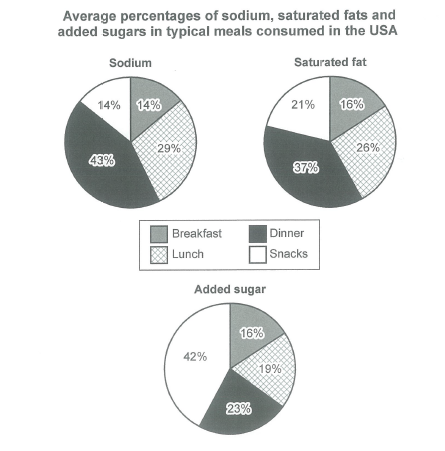
The charts below show the average percentages in typical meals of three types of nutrients, all of which may be unhealthy if eaten too much.
Summarize the information by selecting and reporting the main features, and make comparisons where relevant.
Student answer (Band 5.5)
The pie chart illustrates the average percentage of three types of nutrients that are sodium, saturated fats and added sugars in daily meals eaten in the USA. All these nutrients can be disadvantageous for health if taken excessively in daily diet.
There are three pie charts representing intake of sodium, saturated fats and added sugars respectively. There are four meal timmings in which these food ingredients are consumed, and that are breakfast, lunch, dinner and snacks.
Overall, highest intake of these nutrients is observed during the dinner time, except for added sugar which has the highest intake during snack time. Whereas, the least intake is observed in the breakfast time.
Highest sodium intake is 43 percent which is during the dinner time. lowest is 14 percent during both snack and breakfast times. Sodium intake during lunch is 29 percent. Highest sodium intakes is 37 percent during dinner time and the lowest being 16 percent for breakfast. Saturated fats intake for snacks is 21 percent and for lunch is 26 percent. Highest intake of added sugars is 42 percent recorded in lunch time. lowest sugar intake is 16 percent in breakfast. sugar intake in dinner is 23 percent and 16 percent in lunch.
AI examiner evaluation
| Criterion | Band |
|---|---|
| Task Achievement / Task Response | 5.5 |
| Coherence and Cohesion | 5.5 |
| Lexical Resource | 6.0 |
| Grammatical Range and Accuracy | 5.5 |
| Overall | 5.5 |
Task Achievement / Task Response: Band 5.5
You identify the chart topic and give a useful overview: dinner has the largest shares of sodium and saturated fat, while snacks lead for added sugar. However, several figures are misreported, which limits the accuracy of the summary. You state that saturated fat peaks at 37% in dinner, but then call 16% the lowest for breakfast without clearly distinguishing this from the other meal values; more importantly, you report the highest added-sugar share as 42% in lunch, when it is in snacks. You also give 16% for added sugar in lunch, although lunch is 19%, and omit the correct snack figure in your detailed account. Select the main comparisons carefully and check each value against the chart before reporting it.
Coherence and Cohesion: Band 5.5
The response has a recognisable structure, moving from an introduction to an overview and then to details. The overview helps the reader identify the main pattern, and the meal categories provide a basic organising framework. However, progression becomes unclear in the final paragraph: sodium details are followed by saturated-fat figures, then added sugar, without consistently signalling the change of nutrient. The sentence beginning “Highest sodium intakes is 37 percent” is especially confusing because it appears to describe sodium but gives the saturated-fat figure. Linking words such as “Whereas” are also used as sentence openings without a complete contrast structure. Group the details by nutrient or by meal, and use clear transitions so comparisons are easy to follow.
Lexical Resource: Band 6.0
You use an adequate range of task-related vocabulary, including “average percentage,” “intake,” “highest,” “lowest,” and “respectively,” and the meaning is generally understandable. Some choices are imprecise or repetitive, however: “food ingredients” does not accurately describe nutrients, and “meal timmings” is an unsuitable phrase for meal categories. Repeated use of “intake” and “highest” also makes the report less flexible. There are spelling errors in “timmings” and inconsistent capitalisation of “lowest” and “sugar.” Use standard chart language such as “proportion,” “share,” and “accounted for,” while keeping the wording precise and avoiding claims about consumption that the chart does not establish.
Grammatical Range and Accuracy: Band 5.5
You use mostly straightforward sentence forms and attempt some more complex structures, such as “Overall, highest intake … except for added sugar,” but grammatical control is uneven. Articles are missing in phrases such as “Overall, highest intake” and “lowest is 14 percent”; these should be framed with “the.” The sentence “There are four meal timmings … and that are breakfast…” has an awkward, incomplete construction, and “Highest sodium intakes is 37 percent” has a subject–verb agreement problem. Some punctuation and sentence-boundary choices also make the final paragraph difficult to follow. Build a wider mix of accurate sentences, checking articles, agreement, and complete clause structure before adding comparisons.
See this exact question answered at other band scores. The same prompt compared across bands.
Browse more IELTS Writing model answers or get your own writing scored by the same AI examiner.