Band 5.5 IELTS Writing Task 1 Model Answer
Overall Band Score: 5.5 · Cambridge IELTS 14 · 2026-11-05
IELTS Writing Task 1 question
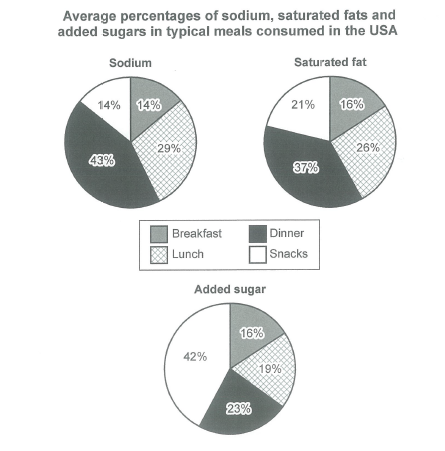
The charts below show the average percentages in typical meals of three types of nutrients, all of which may be unhealthy if eaten too much.
Summarize the information by selecting and reporting the main features, and make comparisons where relevant.
Student answer (Band 5.5)
The pie chart depicts the percentage of three types of nutrients one gets after having a meal.
After comparing all of them we can conclude that majority of nutrients is consumed by dinner meal in case of sodium and saturated fat. However, it might be unhealthy to consume major amount of nutrients. Snacks have great amount of added sugar in it because of that the snacks covers more area in pie chart when we go through the added sugar portion.
After having lunch one can consume 29% of total sodium while 26% of total saturated fat and only 19% of added sugar. This concludes that having lunch is must for sodium intake in our body while saturated fat also helps to get energy that's why lunch is important in day to day life.
Moving on to dinner, after having dinner one consumes major amount of all nutrients compared to others. The amount of sodium, saturated fat and added sugar is very high comparing to others which might lead to very serious issue if not utilised properly. This is the reason why people who eats alot at night have various kind of diseases.
Talking about snacks, it consumes 42% of area in pie chart in terms of added sugar. Consuming more amount of added sugar will lead to serious issues.
AI examiner evaluation
| Criterion | Band |
|---|---|
| Task Achievement / Task Response | 5.5 |
| Coherence and Cohesion | 5.5 |
| Lexical Resource | 5.5 |
| Grammatical Range and Accuracy | 5.5 |
| Overall | 5.5 |
Task Achievement / Task Response: Band 5.5
You identify two important patterns: dinner has the highest shares of sodium and saturated fat, while snacks have the highest share of added sugar. You also report several figures accurately, including lunch’s 29% sodium, 26% saturated fat and 19% added sugar, and snacks’ 42% added sugar. However, the account is only partly focused on summarising the chart. It omits the breakfast figures and gives limited comparison across all four meals; for example, dinner’s 23% added sugar is not reported. The claims that lunch is “must” for sodium intake and that eating a lot at night causes diseases are unsupported by the chart. Keep the response descriptive, include a concise overview, and compare the main highs and lows without adding health advice.
Coherence and Cohesion: Band 5.5
The response has a recognisable structure, moving from an introduction to lunch, dinner and snacks, and linking phrases such as “Moving on to dinner” help signal topic changes. However, the progression is not fully effective as a chart summary: breakfast is omitted, and the meal-by-meal paragraphs do not consistently compare the categories. Some connections are repetitive or unclear, particularly the repeated explanation that high nutrient intake may cause health problems. The opening overview could more clearly establish the main contrasts before the details. Organise the body around the key patterns—for example, dinner’s high sodium and saturated fat versus snacks’ high added sugar—and use comparisons to connect figures rather than repeating general comments.
Lexical Resource: Band 5.5
You use relevant topic vocabulary, including “sodium,” “saturated fat,” “added sugar,” and “percentage,” so the reader can follow the subject. However, the range is limited and several phrases are imprecise or unnatural for describing a chart. “Snacks have great amount” and “consumes 42% of area in pie chart” do not express the data clearly; the chart shows a share or proportion, not an area to be consumed. “Major amount” and “serious issue” are also vague, while “nutrients” is sometimes used where “these nutrients’ shares” would be more precise. Aim for accurate reporting language such as “accounted for,” “proportion,” and “highest share,” and avoid unsupported evaluative wording.
Grammatical Range and Accuracy: Band 5.5
You attempt a mixture of simple statements and longer sentences, and most of the intended meaning remains understandable. However, errors in agreement, articles and sentence construction are noticeable. For example, “majority of nutrients is consumed” needs an article and a plural verb, while “people who eats” has incorrect subject–verb agreement. “After having lunch one can consume 29%” is also awkwardly structured for reporting a chart, and some long sentences join ideas without clear control. There is limited evidence of consistently accurate complex structures. Practise concise comparison sentences, checking singular and plural subjects and verb forms, and use punctuation to separate the chart finding from any explanation.
See this exact question answered at other band scores. The same prompt compared across bands.
Browse more IELTS Writing model answers or get your own writing scored by the same AI examiner.