Band 4.5 IELTS Writing Task 1 Model Answer
Overall Band Score: 4.5 · Cambridge IELTS 14 · 2026-11-06
IELTS Writing Task 1 question
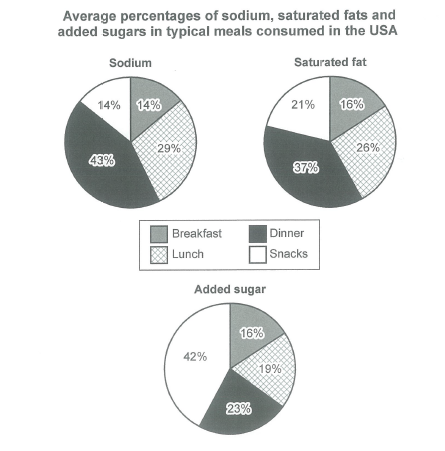
The charts below show the average percentages in typical meals of three types of nutrients, all of which may be unhealthy if eaten too much.
Summarize the information by selecting and reporting the main features, and make comparisons where relevant.
Student answer (Band 4.5)
The charts below at the image , are showing us some of average percentages for a USA citizens consuming meal
wich they countain a sodium and saturated fats and sugars
As we can see the sodium is eaten to much espically on dinner then lunch , wich leave breakfast and snacks have same consumtion
then on saturated fat , same we can see it consume’s a lot on dinner then lunch , but here we can see snacks then breakfast at the last
and the sugar it consume’s more in snacks like candies and cakes , then we have in second the dinner wich is bad for health
then wee see lunch then breakfast
AI examiner evaluation
| Criterion | Band |
|---|---|
| Task Achievement / Task Response | 4.5 |
| Coherence and Cohesion | 4.5 |
| Lexical Resource | 5.0 |
| Grammatical Range and Accuracy | 4.5 |
| Overall | 4.5 |
Task Achievement / Task Response: Band 4.5
You identify the three nutrients and make several relevant comparisons: sodium and saturated fat are highest at dinner, while added sugar is highest in snacks. These observations broadly match the chart, and you also note the lower breakfast figures. However, the response gives no clear, complete overview and reports no percentages, so the scale of the differences is not shown. The claim that sugar in snacks comes from “candies and cakes” is not supported by the chart. The response is also 36 words below the 150-word minimum, leaving the key features underdeveloped. To improve, add a concise overview and support comparisons with accurate figures, while avoiding explanations not shown in the data.
Coherence and Cohesion: Band 4.5
The response follows a basic sequence, discussing sodium, saturated fat and then sugar, and words such as “then” and “but” help signal some comparisons. However, it is presented as one continuous block rather than being organised into a clear introduction, overview and detail paragraphs. Repeated transitions such as “then” make the progression mechanical, and some links are difficult to follow, particularly “wich leave breakfast and snacks have same consumtion.” The reader can identify the general topic, but the relationships between points are not consistently expressed clearly. Use separate paragraphs for the overview and comparisons, and connect the figures with more precise linking phrases such as “by contrast” or “whereas.”
Lexical Resource: Band 5.0
You use some relevant topic vocabulary, including “sodium,” “saturated fat,” “percentages,” “dinner” and “snacks,” which makes the subject recognisable. However, the range is limited and several words or phrases are inaccurate or awkward, such as “consuming meal,” “eaten to much” and “same consumtion.” Spelling errors, including “wich,” “espically” and “consumtion,” are noticeable and sometimes slow the reader. The unsupported examples “candies and cakes” also introduce imprecise content. Build a more accurate set of chart-description phrases, such as “accounted for,” “the highest proportion” and “was followed by,” and check spelling and word forms before submitting.
Grammatical Range and Accuracy: Band 4.5
The response attempts to compare categories using clauses introduced by “then” and “but,” but most sentences rely on simple, loosely connected structures. Errors are frequent and sometimes make the relationships unclear. For example, “wich leave breakfast and snacks have same consumtion” does not form a correct clause, while “the sugar it consume’s more in snacks” has an unclear subject and verb construction. There are also problems with articles and sentence boundaries, as in the opening phrase “The charts below at the image.” Practise writing complete sentences with a clear subject and verb, for example, “Dinner accounts for the largest share of sodium, at 43%.” Then check agreement, articles and punctuation.
See this exact question answered at other band scores. The same prompt compared across bands.
Browse more IELTS Writing model answers or get your own writing scored by the same AI examiner.