Band 5.5 IELTS Writing Task 1 Model Answer
Overall Band Score: 5.5 · Cambridge IELTS 14 · 2026-11-06
IELTS Writing Task 1 question
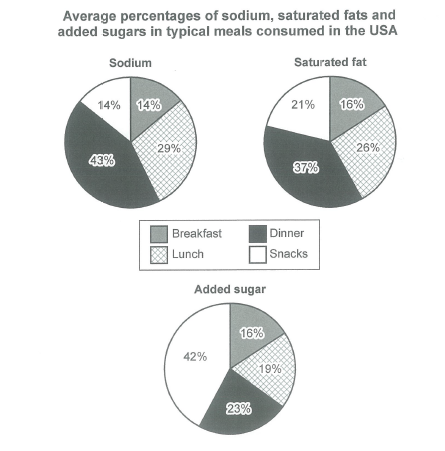
The charts below show the average percentages in typical meals of three types of nutrients, all of which may be unhealthy if eaten too much.
Summarize the information by selecting and reporting the main features, and make comparisons where relevant.
Student answer (Band 5.5)
The pie charts illustrate the average proportion of sodium, saturated fats and added sugar in typical meals consumed by Americans. These nutrients can be unhealthy if eaten too much.
Overall, dinner is the most nutritions meal while breakfast has the lowest number of nutrients. Dinner contains 43% of sodium which is highest in all.
Meals in USA are very sodium enrich. Dinner contains 43% sodium and 23% and 37% of added sugar and saturated fat respectively. Lunch is the second most nutritions meal. sodium is the most profound nutrient in lunch. 29% of sodium with 26% and 19% of saturated fat and added sugar respectively.
Breakfast has the lowest percentage of nutrients. It contains 14% of sodium and 16% of both added sugar and saturated fat. Lastly, snacks contain a big proportion of sugar. Around 42% of sugar can be found in the snacks. It contains 21% of saturated fat and only 14% of sodium.
AI examiner evaluation
| Criterion | Band |
|---|---|
| Task Achievement / Task Response | 6.0 |
| Coherence and Cohesion | 6.0 |
| Lexical Resource | 5.0 |
| Grammatical Range and Accuracy | 5.5 |
| Overall | 5.5 |
Task Achievement / Task Response: Band 6.0
You identify the chart’s subject and report several key figures accurately, including dinner’s 43% sodium and 37% saturated fat, and snacks’ 42% added sugar. You also compare meals, which addresses the main task. However, the overview is unclear and partly inaccurate: calling dinner “the most nutritions meal” overlooks that snacks have the highest added-sugar share, while breakfast is not simply the meal with the “lowest number of nutrients”—it has the lowest sodium figure, but ties for the lowest saturated-fat and added-sugar figures. Some comparisons, such as the overall pattern across all three nutrients, could be stated more precisely. A clearer overview identifying dinner as highest for sodium and saturated fat, and snacks as highest for added sugar, would make the key features more fully developed.
Coherence and Cohesion: Band 6.0
The response has a clear overall arrangement: an introduction, an overview, and paragraphs describing the meal categories. The progression from dinner and lunch to breakfast and snacks is easy to follow, and words such as “Overall” and “Lastly” help signal movement between points. However, the overview’s claim that dinner is the “most nutritions meal” does not clearly express a chart-based comparison, and the repeated pattern of listing figures makes some parts feel mechanical. The sentence “Dinner contains 43% of sodium which is highest in all” is also not smoothly connected to the overview. Grouping the main contrasts—dinner’s high sodium and saturated fat versus snacks’ high sugar—would create a more purposeful progression and clearer links between paragraphs.
Lexical Resource: Band 5.0
You use relevant chart vocabulary such as “proportion,” “percentage,” and “contains,” and the reader can generally understand the comparisons. However, several word choices and collocations are inaccurate or unnatural, including “most nutritions meal,” “sodium enrich,” and “most profound nutrient.” These expressions make the description less precise, especially because the charts show nutrient proportions rather than how nutritious a meal is. “A big proportion” is understandable but informal for an academic report. Aim for standard chart language such as “the highest share,” “accounts for,” and “the largest proportion.” More accurate word forms and collocations would improve clarity and give you greater flexibility without requiring unnecessarily complex vocabulary.
Grammatical Range and Accuracy: Band 5.5
You use a mixture of short statements and longer sentences, and most of the data remains understandable. Some grammatical errors, however, affect accuracy and flow. For example, “Dinner contains 43% of sodium which is highest in all” needs a clearer relative clause and article, such as “Dinner accounts for 43% of sodium, the highest figure among the meals.” In “29% of sodium with 26% and 19% of saturated fat and added sugar respectively,” the figures are presented in a fragment rather than a complete sentence. Capitalisation is also inconsistent in “sodium is the most profound nutrient.” Work on complete sentence structures, articles, and punctuation around comparisons. These changes would help you express the same range of information more accurately.
See this exact question answered at other band scores. The same prompt compared across bands.
Browse more IELTS Writing model answers or get your own writing scored by the same AI examiner.