Band 5.0 IELTS Writing Task 1 Model Answer
Overall Band Score: 5.0 · Cambridge IELTS 14 · 2026-11-06
IELTS Writing Task 1 question
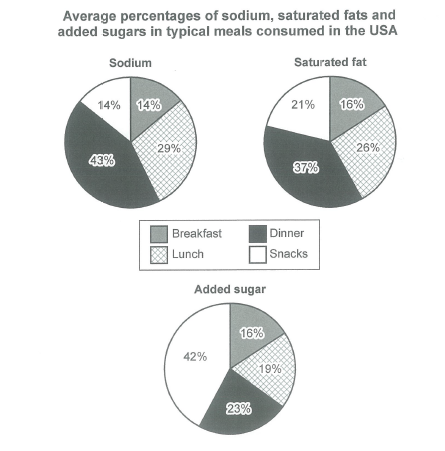
The charts below show the average percentages in typical meals of three types of nutrients, all of which may be unhealthy if eaten too much.
Summarize the information by selecting and reporting the main features, and make comparisons where relevant.
Student answer (Band 5.0)
The three charts illustrates the average percentages of three types of nutrients in different meal which may be harmful if eaten too much.
Overall, sodium and saturated fat has approximately the same structure of consuming meal in the USA while, added sugar has high rating of consuming snacks.
Sodium used by the people in the dinner time is too much high as compared to other of about 43% , 29% in the lunch and 14% for both breakfast and snacks and its approximately goes for saturated salt but the major changes is in the added sugar ,the average use of added sugar in the snacks is 42% and in dinner is 23% which is a major change.
In contrast, added sugar in dinner is far lower than saturated fat and sodium and snacks also breaks the record with a major change change in added sugar of 42% .the most noticeable is breakfast, that has the little bit of changes in all the meal.
AI examiner evaluation
| Criterion | Band |
|---|---|
| Task Achievement / Task Response | 5.5 |
| Coherence and Cohesion | 5.0 |
| Lexical Resource | 5.0 |
| Grammatical Range and Accuracy | 5.0 |
| Overall | 5.0 |
Task Achievement / Task Response: Band 5.5
You identify the main contrast: sodium and saturated fat peak at dinner, while added sugar is highest in snacks. Several figures are reported accurately, including sodium at 43% for dinner and 14% for breakfast and snacks, and added sugar at 42% for snacks. However, the overview is vague (“approximately the same structure”) and does not clearly summarise the key pattern across all three nutrients. The comparison that added sugar in dinner is “far lower” than sodium and saturated fat is not supported by the data: dinner figures are 23%, 37% and 43%, respectively, but the size of the differences is not explained. Develop the overview and compare the meal categories more precisely, including the relatively low breakfast figures.
Coherence and Cohesion: Band 5.0
The response has an opening, an overview and further comparisons, so there is some organisation. However, the progression is difficult to follow because the final paragraph repeats points already made about dinner and snacks rather than adding a distinct comparison. Linking phrases such as “In contrast” do not always signal a clear contrast, and the long third paragraph combines several figures and ideas in one sentence. The reference to “the little bit of changes in all the meal” is also unclear. Organise the report into a concise overview followed by comparisons grouped by nutrient or meal, and use linking expressions only where the relationship between ideas is clear.
Lexical Resource: Band 5.0
You use relevant topic vocabulary, including “sodium,” “saturated fat,” “added sugar,” and “average percentages,” which helps communicate the subject. However, the range is limited and several word choices or collocations sound unnatural, such as “high rating of consuming snacks,” “too much high,” and “breaks the record.” “Saturated salt” is also an inaccurate term for the chart’s nutrient. Repetition of “major change” and “changes” limits precision, while “used by the people” is less suitable than language describing the proportion of a nutrient in meals. Aim for concise, conventional chart-reporting phrases such as “accounted for,” “was highest in,” and “the largest proportion.”
Grammatical Range and Accuracy: Band 5.0
The response attempts longer sentences and uses comparison structures, but errors are frequent and sometimes make relationships between figures harder to understand. For example, “The three charts illustrates” has subject–verb disagreement, and “sodium and saturated fat has” repeats this problem. Articles and plural forms are also inconsistent in “different meal” and “the major changes is.” The sentence beginning “Sodium used by the people in the dinner time” has an unclear grammatical structure, and punctuation is often missing or misplaced, especially around commas and spaces. Practise accurate simple sentences first, then combine them with controlled clauses—for example, “Sodium was highest at dinner, at 43%, compared with 29% at lunch.”
See this exact question answered at other band scores. The same prompt compared across bands.
Browse more IELTS Writing model answers or get your own writing scored by the same AI examiner.