Band 5.5 IELTS Writing Task 1 Model Answer
Overall Band Score: 5.5 · Cambridge IELTS 14 · 2026-11-08
IELTS Writing Task 1 question
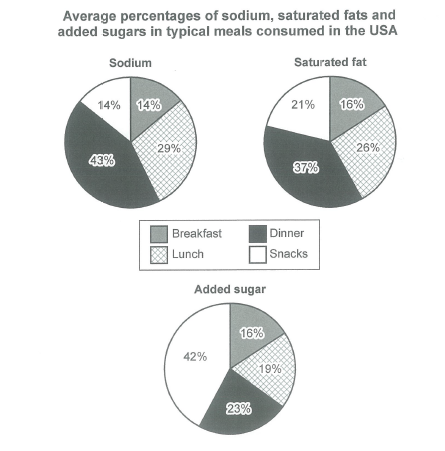
The charts below show the average percentages in typical meals of three types of nutrients, all of which may be unhealthy if eaten too much.
Summarize the information by selecting and reporting the main features, and make comparisons where relevant.
Student answer (Band 5.5)
Meals are crutial in everyones life, that's why, for some healthcare needs, some researches in the USA are done in order to know the amount of some nutrients in different type of meals throughout the day, which are specifically Breakfast, Dinne, Lunch and Snacks in between.
Starting off with the chart of the percentage of the first studied nutrient, the Sodium.
As we can see, its percentage in the breakfast as well as in the snacks is low and equal with only 14%, unlike the lunch and the dinner and obviously it is more dominant in the dinner with 43%.
For the percentage of saturated fat it is quite similar to the sodium charts, where we clearly see its dominance in the lunch and dinner with 26% and 37% in range , but for the snacks it's a little bit higher with 21%.
And finally the last nutrient. Added sugar. Analyzing its chart makes us realize the amout of sugar eaten by americans. Well, snacks took the most remarkable percentage this time with 42% and for the breakfast, dinner and lunch they are almost the same percentage with a little bit of differance.
AI examiner evaluation
| Criterion | Band |
|---|---|
| Task Achievement / Task Response | 5.5 |
| Coherence and Cohesion | 6.0 |
| Lexical Resource | 5.5 |
| Grammatical Range and Accuracy | 5.5 |
| Overall | 5.5 |
Task Achievement / Task Response: Band 5.5
You identify several key patterns accurately: sodium is highest at dinner (43%) and tied at breakfast and snacks (14%), while added sugar peaks in snacks (42%). You also report the saturated-fat figures for lunch, dinner and snacks correctly. However, the overview is not clearly stated, and some comparisons are incomplete: for example, you say breakfast, dinner and lunch have “almost the same” added-sugar percentages without giving their values or noting that they rise from 16% to 23%. The opening also introduces healthcare research that is not shown by the charts. A concise overview of the main contrasts, followed by accurate comparisons across all three nutrients, would make the report more complete and focused.
Coherence and Cohesion: Band 6.0
The response has a clear basic sequence: it introduces the topic, then discusses sodium, saturated fat and added sugar in separate sections. Transitions such as “Starting off” and “And finally” help readers follow this order. However, the organisation is somewhat mechanical, and the opening does not provide a clear overview of the main findings. Some links between ideas are awkward, such as “unlike the lunch and the dinner and obviously it is more dominant,” which makes the comparison harder to follow. The final paragraph also ends without a summarising point. Grouping the main trends in an overview and using more direct comparisons between meal types would create smoother progression.
Lexical Resource: Band 5.5
You use relevant chart vocabulary, including “percentage,” “dominance,” and “nutrient,” and the reader can generally understand the comparisons. However, several word choices and collocations are inaccurate or informal, such as “some researches,” “percentage … is low,” and “took the most remarkable percentage.” There are also spelling errors, including “crutial,” “amout,” and “differance,” which reduce precision. Phrases such as “the amount of some nutrients” are also vague when the chart reports percentages. Aim for precise reporting language and check spelling carefully; this will make your descriptions more natural and suitable for an academic report.
Grammatical Range and Accuracy: Band 5.5
You attempt both simple and more complex sentence forms, including clauses introduced by “where” and “which,” and most of the intended meaning remains understandable. However, some sentence structures are incomplete or awkward. “Starting off with the chart of the percentage of the first studied nutrient, the Sodium” is a fragment, while “unlike the lunch and the dinner and obviously it is more dominant” joins ideas without clear grammatical control. There are also errors in articles, plurals and agreement, as in “different type of meals” and “the percentage … is low and equal.” Use complete sentences, check singular and plural forms, and separate comparisons into clearly structured clauses.
See this exact question answered at other band scores. The same prompt compared across bands.
Browse more IELTS Writing model answers or get your own writing scored by the same AI examiner.