Band 6.5 IELTS Writing Task 1 Model Answer
Overall Band Score: 6.5 · Cambridge IELTS 14 · 2026-11-08
IELTS Writing Task 1 question
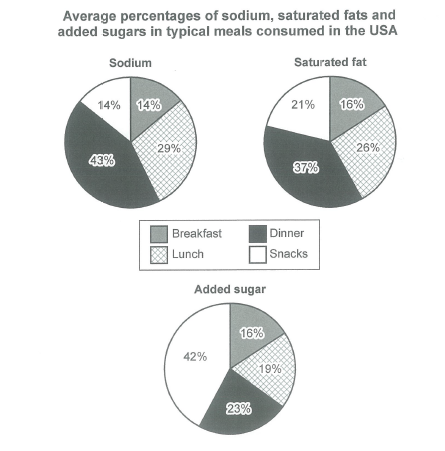
The charts below show the average percentages in typical meals of three types of nutrients, all of which may be unhealthy if eaten too much.
Summarize the information by selecting and reporting the main features, and make comparisons where relevant.
Student answer (Band 6.5)
The given pie chart illustrates information on sodium, saturated fats and added sugars in typical meals consumed by people in USA.
Overall, it is observed people consumed the least amount of these nutrients in breakfast while lunch and dinner contributed to major proportion of intake of these nutrients.
Dinner contributed the most to sodium and saturated fat intake at 43 % and 37% each followed by lunch at 29% and 26% for both these nutrients.Snacks was the major contributor for sugar intake at 42% followed by dinner at 23 % and lunch at 19%.Moreover, snacks also accounted for 14% of sodium and 21% of saturated fat consumption.
Breakfast accounted for the least amount of intake in all the three nutrients at 14%, 16 % and 29% respectively.In conclusion,lunch contributed for majorly in two nutrients while snacks contributed in one.Furthermore, lunch followed dinner in sodium and saturated fat intake while it ranked behind dinner in added sugar intake.
AI examiner evaluation
| Criterion | Band |
|---|---|
| Task Achievement / Task Response | 7.0 |
| Coherence and Cohesion | 6.5 |
| Lexical Resource | 6.5 |
| Grammatical Range and Accuracy | 6.0 |
| Overall | 6.5 |
Task Achievement / Task Response: Band 7.0
You identify the main pattern accurately: dinner has the largest shares of sodium and saturated fat, while snacks lead for added sugar. The comparisons and figures for these features are generally well selected, including dinner’s 43% and 37% and snacks’ 42% for sugar. You also note that breakfast is low across the nutrients. However, the overview overgeneralises by saying people consumed the least of all three nutrients at breakfast: breakfast and snacks are tied for the lowest sodium share at 14%. More importantly, the final sentence says lunch is the major contributor for two nutrients, although dinner is highest for both. The response covers the chart and gives relevant detail, but these inconsistencies limit the precision of the summary.
Coherence and Cohesion: Band 6.5
The response has a recognisable progression from an introduction to an overview and then supporting comparisons. Grouping sodium and saturated fat together is effective, and the contrast with snacks’ leading share of added sugar is easy to follow. However, the final sentence repeats earlier comparisons rather than adding a clear concluding insight, and it conflicts with the preceding data by claiming lunch is the major contributor for two nutrients. Some linking is also mechanical, particularly the repeated use of “followed by” and “Furthermore.” Improve the flow by keeping the overview distinct from the detailed figures and using the final paragraph to synthesise the main contrast without restating or changing the rankings.
Lexical Resource: Band 6.5
You use a suitable range of chart-reporting vocabulary, including “contributed,” “accounted for,” “intake,” and “major contributor,” and the meaning is generally clear. There is some variation in how you describe the data, but several phrases are imprecise or awkward: “major proportion of intake,” “contributed for majorly,” and “in USA.” “Snacks was” also reflects an incorrect word form, while “consumed the least amount” is less natural for percentages of meal contributions. These choices do not prevent understanding, but they limit precision and naturalness. Aim for concise collocations such as “accounted for the largest share” and “the lowest proportion,” and use consistent terms for the meal categories and nutrient shares.
Grammatical Range and Accuracy: Band 6.0
You use both simple statements and more developed structures, such as “while lunch and dinner contributed…” and the comparison beginning “while it ranked behind dinner.” Most of the information remains understandable, but some grammatical errors recur. For example, “people consumed” needs an article or possessive construction (“people in the USA consumed”), and “Snacks was” has a subject–verb agreement error. The sentence “Breakfast accounted for the least amount … at 14%, 16% and 29%” also has a faulty data relationship: the figures do not match breakfast, whose added-sugar share is 16%. Punctuation spacing is inconsistent, with missing spaces after full stops and around percentages. More accurate sentence construction and proofreading would strengthen control.
See this exact question answered at other band scores. The same prompt compared across bands.
Browse more IELTS Writing model answers or get your own writing scored by the same AI examiner.