Band 6.5 IELTS Writing Task 1 Model Answer
Overall Band Score: 6.5 · Cambridge IELTS 14 · 2026-11-08
IELTS Writing Task 1 question
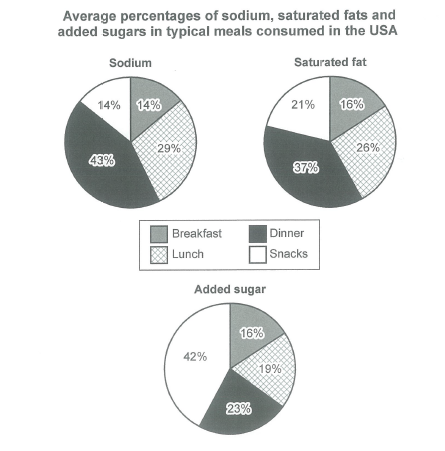
The charts below show the average percentages in typical meals of three types of nutrients, all of which may be unhealthy if eaten too much.
Summarize the information by selecting and reporting the main features, and make comparisons where relevant.
Student answer (Band 6.5)
The pie charts illustrate average percentages of sodium, saturated fats and added sugars in typical meals , all of which may be unhealthy if consumed excessively in the USA. In general, a larger percentage of sodium is consumed during dinner as well as saturated fat consumed during dinner. A larger percentage of added sugar is consumed through snacks. To begin with, the largest percentage of, 43%, sodium is taken during dinner, 29% of it is taken during lunch and equal percentages of it, 14% are taken both during breakfast and as snacks. Secondly, 37% of saturated fat is consumed during dinner, 26% of it is taken during lunch, 21% of it is consumed in snacks whereas a smaller portion of it, 16%, is taken during breakfast. Finally, the largest percentage of added sugar is eaten as snacks, 23% of it eaten as dinner, 19% of it is eaten during lunch and 16% of it is eten as breakfast.
AI examiner evaluation
| Criterion | Band |
|---|---|
| Task Achievement / Task Response | 7.0 |
| Coherence and Cohesion | 6.5 |
| Lexical Resource | 6.5 |
| Grammatical Range and Accuracy | 6.0 |
| Overall | 6.5 |
Task Achievement / Task Response: Band 7.0
The response identifies the chart topic and reports the main patterns accurately: dinner has the highest shares of sodium and saturated fat, while snacks account for the most added sugar. The figures given for sodium and saturated fat are correct, as are the added-sugar figures. This provides a clear overview and relevant supporting detail across all three nutrients. To make the account more fully developed, compare the distributions more directly—for example, note that breakfast is the lowest or joint-lowest meal for each nutrient, and contrast the strong dinner share of sodium with the snack-led pattern for sugar. The overview is clear, but the comparisons remain somewhat limited and the report mainly lists values in sequence.
Coherence and Cohesion: Band 6.5
The response has a clear overall structure: an introduction and overview are followed by separate sections for sodium, saturated fat and added sugar. Sequencing phrases such as “To begin with,” “Secondly” and “Finally” help readers follow the progression. However, the organisation is somewhat mechanical, and the body paragraphs mostly present one figure after another rather than grouping related comparisons across the charts. Some sentence links are also awkward, particularly “a larger percentage of sodium is consumed during dinner as well as saturated fat consumed during dinner,” where the relationship between the two points is not smoothly expressed. Use more varied comparison links and clearer parallel phrasing to make the progression more natural and cohesive.
Lexical Resource: Band 6.5
The vocabulary is adequate for describing the charts, with relevant terms such as “average percentages,” “consumed,” “largest percentage” and “smaller portion.” The writer also varies the wording for intake with “taken,” “eaten” and “consumed,” although some choices are imprecise or repetitive. For example, “a larger percentage … is consumed” is repeated in the overview, and “taken during” is less natural for describing proportions in meals. There is also a spelling error in “eten.” Greater precision in terms such as “accounted for” or “made up,” alongside more varied language for ranking and comparison, would improve flexibility and control. The meaning remains clear throughout.
Grammatical Range and Accuracy: Band 6.0
The response uses a mix of simple statements and longer sentences, and most figures are presented in understandable grammatical structures. Some errors remain, however. In the overview, “as well as saturated fat consumed during dinner” is not a complete parallel construction; it would be clearer to say that dinner accounts for the largest shares of both nutrients. The sentence “23% of it eaten as dinner” is missing a finite verb, such as “is eaten.” Punctuation is also uneven: the phrase “the largest percentage of, 43%, sodium” contains unnecessary commas, and there is an extra space before a comma in the opening sentence. More consistent sentence construction and careful proofreading would strengthen accuracy.
See this exact question answered at other band scores. The same prompt compared across bands.
Browse more IELTS Writing model answers or get your own writing scored by the same AI examiner.