Band 5.0 IELTS Writing Task 1 Model Answer
Overall Band Score: 5.0 · Cambridge IELTS 14 · 2026-11-08
IELTS Writing Task 1 question
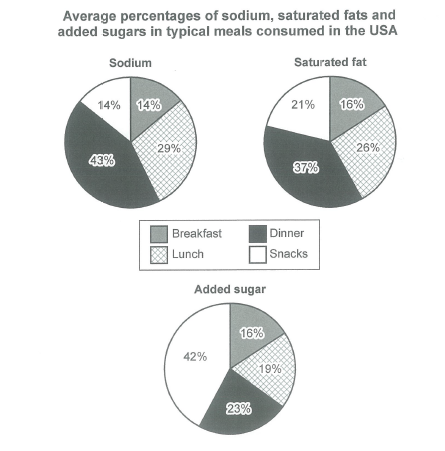
The charts below show the average percentages in typical meals of three types of nutrients, all of which may be unhealthy if eaten too much.
Summarize the information by selecting and reporting the main features, and make comparisons where relevant.
Student answer (Band 5.0)
These pie charts ellustrates average proportion of three nutrients added in breakfast, lunch, snacks and dinner.
Overall, proportion of eating sodium remained same from breakfast to dinner wherease, fat and sugar consumption increased too. In addition, cosumption of sugar rose dramatically while taking snacks. However, proportion of taking sodium and fat increased mainly in diiner time where percentage of sugar intake rose mainly while eating snacks.
In detail, percentage of sodium remained same from 16% from breakfast to snacks which rose more than 3 folds in dinner. Percentage of taking fat(16%) and sugar(16%) increased to 21% and 42% respectively from breakfast to snacks. In addition, people ate highest proportion of sodium and fat in dinner.
Turning to the remaining proportion, percentage of taking sugar increased(42%) significantly
which was 16% in breakfast.
AI examiner evaluation
| Criterion | Band |
|---|---|
| Task Achievement / Task Response | 5.0 |
| Coherence and Cohesion | 5.0 |
| Lexical Resource | 5.5 |
| Grammatical Range and Accuracy | 5.0 |
| Overall | 5.0 |
Task Achievement / Task Response: Band 5.0
You identify the subject and make a useful broad comparison: dinner has the highest sodium and saturated-fat shares, while snacks lead for added sugar. However, the report is only a partial summary, and several figures are inaccurate or unclear. Sodium is not “the same from 16%” at breakfast and snacks; both are 14%, and dinner’s 43% is just over three times that figure. The overview also says sodium remained the same “from breakfast to dinner,” although it rises substantially at lunch and dinner. Important comparisons, especially lunch and the full distribution across meals, are largely omitted. The response is also 19 words below the required minimum. Include a more accurate overview and select key figures across all four meals to develop the summary.
Coherence and Cohesion: Band 5.0
The response has a recognisable structure, with an introduction, an overview and two detail paragraphs, and phrases such as “Overall” and “In detail” help signal the sections. However, progression is limited because the final paragraph repeats the snack sugar figure already given, rather than adding a new comparison. Some links are confusing: “wherease” connects claims that do not clearly contrast, and “Turning to the remaining proportion” does not identify what information follows. The overview also combines several points in a way that makes the trends difficult to follow. Organise the details by meal or nutrient, and use clear comparisons between breakfast, lunch, dinner and snacks. This would make the report’s progression easier to understand and reduce repetition.
Lexical Resource: Band 5.5
You use relevant task vocabulary, including “proportion,” “consumption,” “increased” and “dramatically,” and the reader can generally identify the nutrients and meals being discussed. However, several spelling and word-choice errors are noticeable, such as “ellustrates,” “cosumption” and “diiner.” Some phrases are also imprecise or unnatural, including “proportion of eating sodium,” “taking fat” and “rose more than 3 folds.” These choices sometimes make the intended comparison harder to interpret. Aim for accurate chart-reporting collocations such as “the proportion of sodium,” “fat intake” and “more than tripled.” Check spelling carefully and avoid repeating “percentage of taking” when a more direct noun phrase would be clearer.
Grammatical Range and Accuracy: Band 5.0
You attempt both simple and more extended sentence forms, including a contrast introduced by “However” and a relative clause in “which was 16% in breakfast.” Nevertheless, errors occur frequently and sometimes obscure the relationships between figures. For example, “proportion of eating sodium remained same” is missing necessary grammatical elements, while “from 16% from breakfast to snacks” has an unclear comparison structure. The sentence beginning “Overall” also joins clauses awkwardly, and “which was 16% in breakfast” has an unclear reference. Use complete, direct comparison patterns, such as “Sodium accounted for 14% at breakfast and snacks, compared with 43% at dinner.” Practise articles, verb forms and sentence boundaries to make these comparisons more reliable.
See this exact question answered at other band scores. The same prompt compared across bands.
Browse more IELTS Writing model answers or get your own writing scored by the same AI examiner.