Band 5.5 IELTS Writing Task 1 Model Answer
Overall Band Score: 5.5 · Cambridge IELTS 14 · 2026-11-08
IELTS Writing Task 1 question
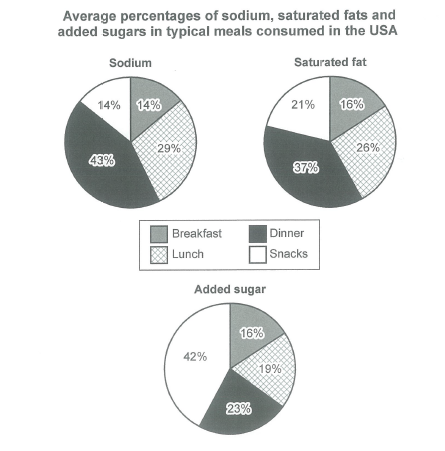
The charts below show the average percentages in typical meals of three types of nutrients, all of which may be unhealthy if eaten too much.
Summarize the information by selecting and reporting the main features, and make comparisons where relevant.
Student answer (Band 5.5)
the charts illustreates that three number of food taken by USA people in their breakfast,dinner,lunch and snacks.
To begin with,sodium is the most taken item in the dinner(43%) and second position is lunch but the equal percentage of sodium eat on breakfast and snacks(14%).After that,saturated fat is also popular on the dinner and other three items quite similler percentage of food take.Lastly,added suger is the highest on the snacks(42%) and just 16% is on the breakfast that is the lowest. On the dinner and lunch, the amount of added suger is 23% and 19% comparatabely.
Overall,it is clear that the amont of 3 food item is more popular in the dinner and the lowest taken on breakfast but added suger is number one on snacks.
AI examiner evaluation
| Criterion | Band |
|---|---|
| Task Achievement / Task Response | 5.5 |
| Coherence and Cohesion | 5.5 |
| Lexical Resource | 5.0 |
| Grammatical Range and Accuracy | 5.0 |
| Overall | 5.5 |
Task Achievement / Task Response: Band 5.5
You identify several important features accurately: sodium peaks at dinner (43%) and is equal at breakfast and snacks (14%), while added sugar is highest in snacks (42%) and lowest at breakfast (16%). However, the overview that “3 food item is more popular in the dinner” is too broad: dinner leads for sodium and saturated fat, but not added sugar. The saturated-fat figures are not reported, and the comparison that its other meal percentages are “quite similar” overlooks the spread from 16% to 26%. The response also contains fewer than the required 150 words, so the summary is underdeveloped. Include the key saturated-fat values and make the overall comparison more precise.
Coherence and Cohesion: Band 5.5
The response has a basic structure, moving from an opening statement to details and then an overall summary. Sequencing phrases such as “To begin with,” “After that,” and “Lastly” help signal the order of points. However, the progression is not consistently clear: the opening does not establish the main comparisons, and the body groups information by nutrient without fully explaining how the meal patterns compare. Some linking is mechanical, and the final overview repeats the dinner and breakfast point rather than synthesising all three nutrients. Use separate, clearly focused paragraphs and connect comparisons explicitly—for example, contrast dinner’s high sodium and saturated fat with snacks’ high added sugar.
Lexical Resource: Band 5.0
You use some relevant chart vocabulary, including “percentage,” “highest,” “lowest,” and “equal,” so the reader can understand the general comparisons. However, the range is limited and several word choices or collocations are inaccurate, such as “food taken,” “popular,” and “the amount of added suger.” These expressions make the description sound imprecise because the chart reports nutrient shares in meals, not popularity or quantities of food. Spelling errors such as “illustreates,” “similler,” and “comparatabely” are also noticeable. Build a more accurate set of terms for describing proportions and rankings, and check spelling carefully; this will make the comparisons clearer and more appropriate for an academic report.
Grammatical Range and Accuracy: Band 5.0
The response mainly uses simple sentence patterns, with a few attempts to combine ideas using “and” and “but.” Some meaning is understandable, but frequent errors in sentence construction and agreement make parts difficult to follow. For example, “the charts illustreates” has a subject–verb agreement problem, while “the equal percentage of sodium eat on breakfast and snacks” lacks a clear grammatical structure. The opening phrase “three number of food” is also not formed correctly. Punctuation and spacing are inconsistent, particularly around commas and full stops. Practise accurate comparison sentences, such as “Sodium accounted for the same proportion at breakfast and in snacks,” before attempting longer, joined sentences.
See this exact question answered at other band scores. The same prompt compared across bands.
Browse more IELTS Writing model answers or get your own writing scored by the same AI examiner.