Band 6.0 IELTS Writing Task 1 Model Answer
Overall Band Score: 6.0 · Cambridge IELTS 14 · 2026-11-08
IELTS Writing Task 1 question
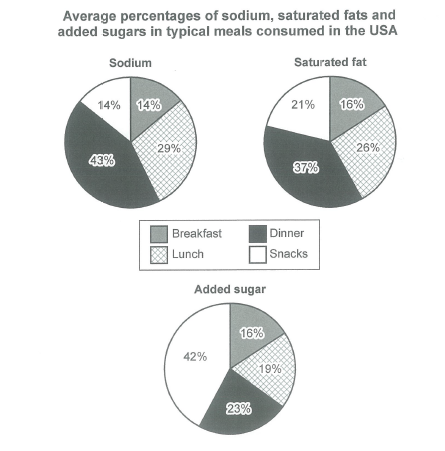
The charts below show the average percentages in typical meals of three types of nutrients, all of which may be unhealthy if eaten too much.
Summarize the information by selecting and reporting the main features, and make comparisons where relevant.
Student answer (Band 6.0)
"The pie charts illustrate the average percentages of sodium, saturated fat and added sugar
in typical meals.
Regarding sodium, dinner accounted for the highest proportion at 43%, followed by lunch at 29%. Meanwhile, breakfast and snacks each represented 14%.
For saturated fat, dinner had the highest percentage at 37%, while breakfast accounted for the lowest proportion at 16%. Lunch represented 26%, and snacks accounted for 21%.
In terms of added sugar, snacks had the highest proportion at 42%, followed by dinner at 23%. Lunch accounted for 19%, while breakfast represented the lowest percentage at 16%.These are the unhealthy meals which people used everyday.These nutrients were also negatively effect on body's life,if they were used unhealthy or in a bad sequeunce.
Overall, dinner contained the highest proportion of sodium which was 43% and saturated fat which was 37% whereas snacks had the highest proportion of added sugar which were 42%during these meals."
AI examiner evaluation
| Criterion | Band |
|---|---|
| Task Achievement / Task Response | 6.5 |
| Coherence and Cohesion | 6.5 |
| Lexical Resource | 5.5 |
| Grammatical Range and Accuracy | 5.5 |
| Overall | 6.0 |
Task Achievement / Task Response: Band 6.5
The response reports the main figures accurately and covers all three nutrients, identifying dinner as the largest source of sodium and saturated fat and snacks as the largest source of added sugar. The comparisons within each chart are also clear, such as dinner at 43% versus breakfast and snacks at 14% for sodium. This gives the report a sound overview, although the overview appears only at the end and largely repeats details already given. The comments about nutrients being unhealthy and affecting people’s lives are not supported by the charts and do not help summarize the data. To strengthen the response, present the key overall pattern near the beginning and focus the remaining discussion on meaningful comparisons across meal types.
Coherence and Cohesion: Band 6.5
The information is arranged in a generally logical sequence: sodium, saturated fat, then added sugar, followed by an overall statement. Paragraphing helps distinguish the three sets of data, and linking phrases such as “Meanwhile,” “For,” and “In terms of” guide the reader. However, the final overview comes after the detailed figures rather than establishing the main trends first, and the unrelated comments about health interrupt the data-focused progression. The conclusion also repeats information already reported. A clearer overview paragraph at the start, followed by grouped comparisons and a concise ending, would make the progression more purposeful. Check spacing after full stops, particularly in “16%.These,” to keep the presentation smooth.
Lexical Resource: Band 5.5
The response uses an adequate range of task-relevant terms, including “accounted for,” “proportion,” and “represented,” and these allow the figures to be reported clearly. However, the repeated use of “highest proportion” and “accounted for” makes the wording somewhat repetitive, while some expressions are inaccurate or unnatural. For example, “unhealthy meals” mislabels the chart’s nutrients, and “bad sequeunce” is both misspelled and unsuitable for describing the data. “Negatively effect on body's life” is also an unclear word choice and collocation. Use precise language about nutrient percentages and avoid adding vague claims that the charts do not show. More varied, accurate reporting verbs would improve flexibility.
Grammatical Range and Accuracy: Band 5.5
Most of the data-reporting sentences are clear and grammatically controlled, with accurate simple structures such as “Lunch represented 26%” and a comparative sentence using “while.” There is some variety in sentence openings and clause patterns, but the response relies mainly on short, simple statements. Errors become more noticeable in the added commentary and final sentence: “These are the unhealthy meals which people used everyday” has an unclear relative clause and tense, while “which were 42%” does not agree with the singular subject “proportion.” The sentence beginning “These nutrients were also…” is also structurally faulty. Improve control by keeping sentences focused and checking subject–verb agreement, clause construction, and punctuation; for example, add a space after the full stop in “16%.These.”
See this exact question answered at other band scores. The same prompt compared across bands.
Browse more IELTS Writing model answers or get your own writing scored by the same AI examiner.