Band 6.0 IELTS Writing Task 1 Model Answer
Overall Band Score: 6.0 · Cambridge IELTS 14 · 2026-11-09
IELTS Writing Task 1 question
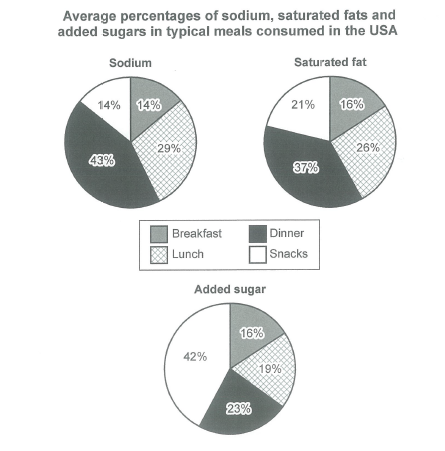
The charts below show the average percentages in typical meals of three types of nutrients, all of which may be unhealthy if eaten too much.
Summarize the information by selecting and reporting the main features, and make comparisons where relevant.
Student answer (Band 6.0)
The pie charts illustrate the average percentage of sodium, saturated fat and added sugar in typical meals consumed in the USA and these type of meals should be unhealthy if consumed too much.
Overall, sodium have the highest quantity in dinner around 43% than other nutrients although, saturated fat also contribute 37% in dinner food. Added sugar in snacks contribute to second highest value than others.
Sodium is added less in snacks approximately 14% which is less than any other nutrients. In contrast saturated fat is added only 21% in snacks but added sugar is 42% added in snacks. Only dinner food have larger quantity of sodium, saturated fat and added sugar around (43%,37%,23%).
If we talk about Lunch 29% of sodium is added, 26% of saturated fat and 19% of added sugar so, lunch have less nutrient value than dinner and snacks. The safest food is breakfast because it contain least amount of all three nutrients (14%,16% and 16%).
AI examiner evaluation
| Criterion | Band |
|---|---|
| Task Achievement / Task Response | 6.5 |
| Coherence and Cohesion | 6.0 |
| Lexical Resource | 5.5 |
| Grammatical Range and Accuracy | 5.0 |
| Overall | 6.0 |
Task Achievement / Task Response: Band 6.5
You identify the main pattern that dinner has the highest shares of sodium and saturated fat, and that snacks have the highest added sugar; these are central features of the charts. You also include figures for all four meal types, so the response is relevant and covers the task. The comparison that breakfast has the lowest values is useful, although calling it “the safest food” goes beyond what the charts establish: they show nutrient proportions, not overall safety. Some comparisons are also unclear, such as saying lunch has less “nutrient value” than dinner and snacks, when the figures vary by nutrient. To strengthen the overview, state the contrasting peaks clearly and compare the meal patterns without making health claims.
Coherence and Cohesion: Band 6.0
The response has a recognisable structure: an introduction, an overview, and paragraphs describing the figures. This gives the reader a coherent overall route through the information. However, progression is sometimes weakened by unclear links and repetitive phrasing. For example, “If we talk about Lunch” introduces a list rather than a focused comparison, while “so, lunch have less nutrient value than dinner and snacks” does not clearly explain which values are lower. The overview also combines several points in a long sentence, with “although” used awkwardly. Grouping the information around the contrasting peaks—dinner for sodium and saturated fat, snacks for sugar—would make the organisation more purposeful. Use linking words selectively and ensure each comparison follows clearly from the figures.
Lexical Resource: Band 5.5
You use relevant chart vocabulary, including “average percentage,” “contribute,” and “amount,” and the reader can generally understand the nutrient comparisons. However, the range is limited and several word choices or collocations are inaccurate. “Sodium is added less in snacks” and “saturated fat is added” suggest ingredients are being added, rather than reporting their shares in meals. “Quantity” and “nutrient value” are also imprecise for percentages, and “safest food” makes an unsupported health judgement. Aim for accurate reporting verbs and terms such as “accounts for,” “share,” and “proportion.” This would make the description more precise and appropriately formal while retaining the clear basic meaning of your current response.
Grammatical Range and Accuracy: Band 5.0
You attempt both simple and more complex sentences, and the main figures are usually understandable. However, errors in agreement, articles, sentence construction, and punctuation are frequent enough to make some sentences awkward. For example, “sodium have” should be “sodium has,” and “these type of meals” should be “this type of meal” or “these types of meals.” In “Only dinner food have larger quantity,” the subject–verb agreement and article use need correction. The sentence beginning “Overall” also joins ideas with “although” in an incomplete or awkward structure. Practise building accurate comparison sentences, checking singular and plural agreement, and using full stops or commas to separate clauses. Greater control of these patterns would improve clarity.
See this exact question answered at other band scores. The same prompt compared across bands.
Browse more IELTS Writing model answers or get your own writing scored by the same AI examiner.