Band 6.0 IELTS Writing Task 1 Model Answer
Overall Band Score: 6.0 · Cambridge IELTS 14 · 2026-11-09
IELTS Writing Task 1 question
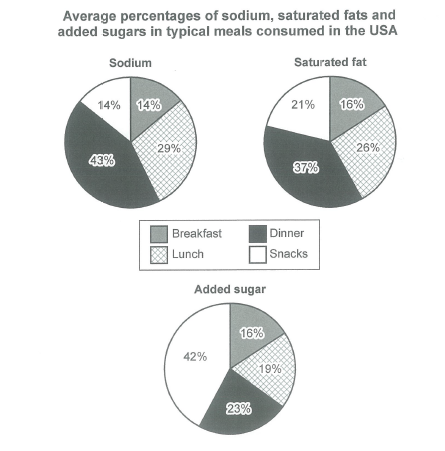
The charts below show the average percentages in typical meals of three types of nutrients, all of which may be unhealthy if eaten too much.
Summarize the information by selecting and reporting the main features, and make comparisons where relevant.
Student answer (Band 6.0)
The pie charts given illustrate the average percentage of three different nutrients in daily typical meals taken by people in the USA. The three ingredients are Sodium, Saturated fat and Sugar.
The charts demonstrate that the quantity of sodium and sturated fat is high in the dinner meals which is at 43% and 37% respectively. Whereas snakcs contribute to the highest source of added sugar with 42%.
However, lunch meal has been the second highest source of sodium and added fat proportioned at 29% and 26% respectively. Whereas the sodium percentage in breakfast and snacks is the same at 14%. However staturated fat contribute a slightly higher percentage in the breakfast and snakcs which 16% and 21% respectively.
Moreover, the percentage of added sugar is least in the breakfast which is 16% and slightly high in the lunch and dinner weighted at 19% and 23%.
The given data conifrms that the breakfast meal is the lowest source of these nutrients with sodium at 14% and saturated fat and added sugar both at 16%.
AI examiner evaluation
| Criterion | Band |
|---|---|
| Task Achievement / Task Response | 6.5 |
| Coherence and Cohesion | 6.0 |
| Lexical Resource | 6.0 |
| Grammatical Range and Accuracy | 5.5 |
| Overall | 6.0 |
Task Achievement / Task Response: Band 6.5
You identify the main contrasts accurately: dinner has the highest shares of sodium and saturated fat, while snacks lead for added sugar. You also report several supporting figures correctly, including lunch’s 29% sodium and 26% saturated fat, and the equal 14% sodium shares for breakfast and snacks. The closing point that breakfast is lowest overall is a useful overview, although it could be stated more clearly as a comparison across the three nutrients. Some details are less fully handled: the added-sugar pattern is described, but the comparison between snacks and the other meals could be integrated into the overview, and “added fat” is not the chart’s label. A more concise, clearly prioritised overview would strengthen the response further.
Coherence and Cohesion: Band 6.0
The response has a generally clear sequence: it introduces the charts, reports the leading meal for each nutrient, then gives further comparisons and a concluding summary. This makes the information understandable overall. However, the progression is sometimes mechanical, with repeated “Whereas” and “However” introducing points that are not always contrasts; for example, the sentence about lunch begins with “However” without a clear opposing idea. The final sentence also repeats the claim that breakfast is lowest after the preceding details have already established this. Grouping the figures into a more deliberate overview and two comparison paragraphs, and using linking expressions only where their relationship is clear, would make cohesion smoother.
Lexical Resource: Band 6.0
You use an adequate range of task-related vocabulary, including “average percentage,” “highest source,” “proportion,” and “contribute,” so the chart’s subject is generally clear. There are, however, several inaccurate or awkward choices: “ingredients” is not precise for nutrients, “quantity” is less suitable for percentages, and “added fat” changes the chart category from saturated fat. “Weighted at” is also an unnatural way to introduce the figures. Spelling slips such as “sturated,” “snakcs,” “staturated,” and “conifrms” reduce the accuracy of the vocabulary. Choose standard chart language consistently and proofread key labels; this would make the adequate range more precise and reliable.
Grammatical Range and Accuracy: Band 5.5
You attempt a mix of simple statements and more complex comparisons, and the main information remains understandable. Some sentence structures are not fully controlled, however. In “Whereas staturated fat contribute a slightly higher percentage in the breakfast and snakcs which 16% and 21% respectively,” the clause lacks a clear verb after “which,” and the subject–verb agreement is incorrect. The opening “The pie charts given illustrate” is also awkwardly formed, while “the breakfast meal” and “in the lunch” show inconsistent article use. Several sentences begin with “Whereas” or “However” as fragments or loosely attached clauses. Build complete sentences around each comparison and check agreement, articles, and punctuation.
See this exact question answered at other band scores. The same prompt compared across bands.
Browse more IELTS Writing model answers or get your own writing scored by the same AI examiner.