Band 5.5 IELTS Writing Task 1 Model Answer
Overall Band Score: 5.5 · Cambridge IELTS 14 · 2026-11-09
IELTS Writing Task 1 question
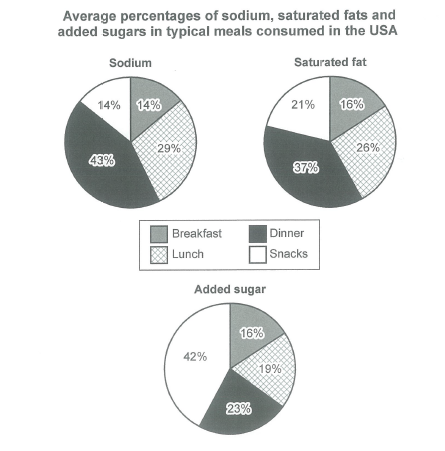
The charts below show the average percentages in typical meals of three types of nutrients, all of which may be unhealthy if eaten too much.
Summarize the information by selecting and reporting the main features, and make comparisons where relevant.
Student answer (Band 5.5)
The pie charts illustrate the consumption of three different nutrients in meals, and it has side effect of consuming too much.
overall,majority of sodium were held in dinner then other meals, this percentage is similar also for saturated fat. But,the propotion of suger is high for snakes,in the USA
For, sodium over half of percentage is used in dinner about 43%,and same pecentage for breakfast and snacks (14% for each ).over one-third of them used in lunch. Saturated fat, 37% is allocated to dinner and other remaining percentage is similar as sodium consumption. About 26% is dedicated to lunch , 21% and 16% for snacks and breakfast respectively. The suger cycle shows different as compare to others, most of suger is used in snacks and than dinner around 42% is used in snacks and 23% for dinner, For, breakfast it has 16% and 19% for lunch in USA.
AI examiner evaluation
| Criterion | Band |
|---|---|
| Task Achievement / Task Response | 5.5 |
| Coherence and Cohesion | 5.5 |
| Lexical Resource | 5.0 |
| Grammatical Range and Accuracy | 5.0 |
| Overall | 5.5 |
Task Achievement / Task Response: Band 5.5
You identify the main contrasts: dinner has the largest shares of sodium and saturated fat, while snacks lead for added sugar. Most figures are reported accurately, including sodium at 43% for dinner and 14% for breakfast and snacks, and added sugar at 42% for snacks. However, the overview is brief and some comparisons are unclear or imprecise; for example, “over one-third” for sodium at lunch is inaccurate because the figure is 29%. The description also says nutrients are “used” in meals, which does not clearly explain that the charts show their percentages across meals. The response is two words below the required minimum, and the data description would benefit from a clearer, more complete overview and precise reporting.
Coherence and Cohesion: Band 5.5
There is a basic overall structure: an introduction and overview are followed by details about sodium, saturated fat and added sugar. This gives the reader a general route through the information. However, progression within sentences is sometimes difficult to follow, as in “For, sodium over half of percentage is used in dinner about 43%,” and the final sentence repeats several figures without a clear comparison. Linking words such as “But” and “and” are used mechanically or with awkward punctuation, while references such as “them” and “the suger cycle” are unclear. Use separate, clearly organised paragraphs for the overview and data details, and connect comparisons directly—for example, contrast dinner’s high sodium share with snacks’ high added-sugar share.
Lexical Resource: Band 5.0
You use some relevant chart vocabulary, including “percentage,” “allocated” and “dedicated,” and you attempt to compare the meal categories. However, the range is limited and several word choices or collocations make the meaning unclear. “Consumption of nutrients in meals” and “percentage is used” do not accurately express the proportions shown, while “suger cycle” is not an appropriate description of the added-sugar data. Spelling errors such as “propotion,” “pecentage,” “suger” and “snakes” are noticeable and can distract the reader. Aim for precise, repeated-use chart language such as “accounted for,” “share” and “proportion,” and check spelling carefully before submitting.
Grammatical Range and Accuracy: Band 5.0
The response attempts both short statements and longer sentences, but the range is limited and errors occur frequently enough to make some parts difficult to interpret. For example, “majority of sodium were held in dinner” has problems with the article, agreement and sentence construction; “this percentage is similar also for saturated fat” is awkwardly formed; and “For, breakfast it has 16%” has faulty punctuation and an unclear subject. Several sentences join multiple figures with commas rather than using controlled clauses, as in the final sentence. Practise building accurate comparison sentences with a clear subject and verb, such as “Dinner accounted for 43% of sodium, compared with 29% at lunch.” Check agreement, articles and punctuation in each sentence.
See this exact question answered at other band scores. The same prompt compared across bands.
Browse more IELTS Writing model answers or get your own writing scored by the same AI examiner.