Band 5.0 IELTS Writing Task 1 Model Answer
Overall Band Score: 5.0 · Cambridge IELTS 14 · 2026-11-10
IELTS Writing Task 1 question
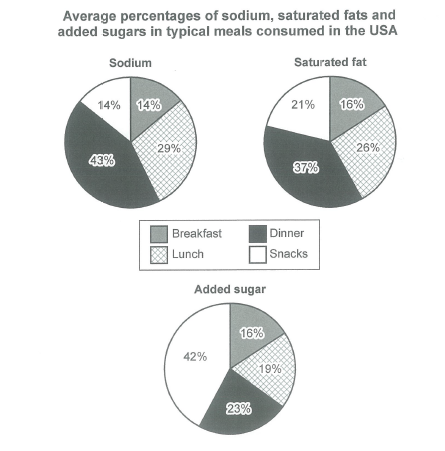
The charts below show the average percentages in typical meals of three types of nutrients, all of which may be unhealthy if eaten too much.
Summarize the information by selecting and reporting the main features, and make comparisons where relevant.
Student answer (Band 5.0)
The charts below illustrates the percentages in normal meals of three types of nutrients, all of which may be unhealthy if eaten extremely.
We will start with sodium, the most percentage of it added on dinner dishes. Sancks and breakfast have the same place with about fourteen percent for each one of them. The middle one is lunch with over than a quarter of all.
Secondly, saturated fat which added to the snacks more than sodium for about seven percent, so it is nearly to lunch that declined to twenty six percent. The majority is same as the last one with about less than two fifths. Breakfast is just over the previous one rising by two percent only.
Finally, added sugar is different the largly one is snacks, it is higher than fourteen percent. The second place is regarded by dinner meals with less than a quarter of percent, meanwhile the midest ones are breakfast and lunch.
In conclusion, we can consider the differences between every nutrient in which typical meal is added more than others.
AI examiner evaluation
| Criterion | Band |
|---|---|
| Task Achievement / Task Response | 5.0 |
| Coherence and Cohesion | 5.5 |
| Lexical Resource | 5.0 |
| Grammatical Range and Accuracy | 5.0 |
| Overall | 5.0 |
Task Achievement / Task Response: Band 5.0
You identify the three nutrients and report several relevant comparisons, including dinner as the highest source of sodium and saturated fat, and snacks as the highest source of added sugar. However, coverage is partial and some figures or comparisons are unclear or inaccurate. For example, “the most percentage of it added on dinner dishes” does not clearly state sodium’s 43%, and “higher than fourteen percent” does not accurately describe snacks’ 42% share of added sugar. The overview is also weak: the conclusion says only that meals differ, rather than summarising the main pattern across the charts. To strengthen the response, state the key highs and lows clearly and support them with accurate figures.
Coherence and Cohesion: Band 5.5
The response has a basic sequence, moving from sodium to saturated fat and then added sugar, and paragraph breaks help distinguish these sections. Linking expressions such as “Secondly” and “Finally” make the order easy to follow. However, progression within paragraphs is sometimes difficult to track because comparisons are compressed or imprecise, as in “The majority is same as the last one” and “the midest ones are breakfast and lunch.” The final sentence repeats the idea of differences without providing a useful overall summary. Use clearer topic sentences and connect each comparison explicitly to the relevant meal and percentage; a concise overview at the beginning would also give the report a stronger overall structure.
Lexical Resource: Band 5.0
You use some task-related vocabulary, including “sodium,” “saturated fat,” “added sugar,” “majority,” and “percent,” so the reader can recognise the subject. However, the range is limited and several word choices or collocations make the meaning difficult to understand. Phrases such as “the most percentage,” “added on dinner dishes,” and “the largly one” are not natural ways to describe chart data; “Sancks” is also misspelled. “The middle one” and “the previous one” are vague when comparing meal categories. Aim for precise reporting language such as “accounted for,” “highest proportion,” and “followed by,” and check spelling and word forms carefully.
Grammatical Range and Accuracy: Band 5.0
The response attempts both simple statements and longer comparative sentences, but control is inconsistent, and errors sometimes make relationships between ideas hard to follow. For example, “The charts below illustrates” has subject–verb disagreement, while “Breakfast is just over the previous one rising by two percent only” has an unclear comparison and awkward clause structure. The sentence beginning “Secondly, saturated fat which added to the snacks” is also incomplete as written. Most sentences rely on basic patterns, and attempts to combine information often lead to faulty structures. Practise complete sentences with a clear subject and verb, and use controlled comparative forms, such as “Snacks account for 21%, compared with 14% for sodium.”
See this exact question answered at other band scores. The same prompt compared across bands.
Browse more IELTS Writing model answers or get your own writing scored by the same AI examiner.