Band 5.0 IELTS Writing Task 1 Model Answer
Overall Band Score: 5.0 · Cambridge IELTS 14 · 2026-11-10
IELTS Writing Task 1 question
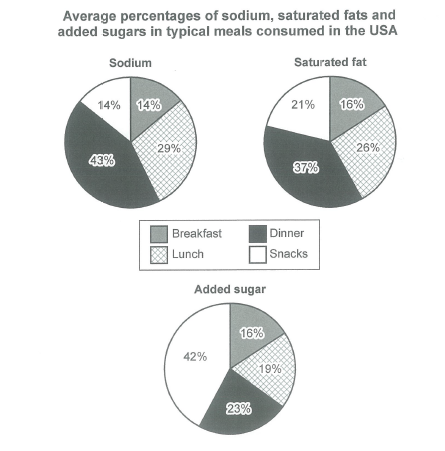
The charts below show the average percentages in typical meals of three types of nutrients, all of which may be unhealthy if eaten too much.
Summarize the information by selecting and reporting the main features, and make comparisons where relevant.
Student answer (Band 5.0)
The three pie charts compares the average percentage of sodium,fats and sugars added in all three meals eated in the USA,
Dinner contains huge amount of sodium while breakfast has equal number of sugar and fat.Moreover,the huge amount of sugar is in the snacks.
Firsly,dinners made of almost 50 percent of sodium and more than 35 percent of saturated fats.The sugar rate in dinner is bit lower than the other two.Moreover,if we talk about breakfast,it has same amount of sugar and fat around 15 while sodium is 14 percent.
Lunch have almost same amount of sodium and fat around 25 to 30 percent but the sugar percenage is more lower .Moreover, snacks has 42 percentage of sugar and sodium rate is almost 15 in it.Moreover, 21 percent of saturated fat in it
AI examiner evaluation
| Criterion | Band |
|---|---|
| Task Achievement / Task Response | 5.0 |
| Coherence and Cohesion | 5.0 |
| Lexical Resource | 5.0 |
| Grammatical Range and Accuracy | 5.0 |
| Overall | 5.0 |
Task Achievement / Task Response: Band 5.0
You identify the main pattern that dinner has the highest sodium and saturated-fat shares, while snacks have the most added sugar, and you include several relevant figures. However, the report is under the required 150 words, and the coverage is partial: lunch and snacks receive only brief, loosely expressed comparisons, and there is no clear, complete overview of how the three nutrients differ across all meals. Some figures are also imprecise: dinner sodium is 43%, rather than “almost 50 percent,” and lunch saturated fat is 26%, not simply around 25 to 30%. Develop the overview and report the key contrasts accurately, using the chart’s exact values where useful.
Coherence and Cohesion: Band 5.0
The response has some organisation: it begins with a general statement, then discusses dinner and breakfast before moving to lunch and snacks. This gives the reader a basic route through the information. However, the progression is not consistently clear, and several points are joined mechanically with repeated “Moreover.” The opening overview is compressed into a run-on sentence, while the final paragraph lists snack figures without a clear comparison or concluding summary. Use distinct paragraphs for the overview and the main comparisons, and connect related figures with more varied, precise linking. This would make the relationships between meals and nutrients easier to follow.
Lexical Resource: Band 5.0
You use some relevant chart vocabulary, including “percentage,” “sodium,” “saturated fats,” and “amount,” so the topic is generally understandable. However, the range is limited and several word choices or forms are inaccurate or unnatural, such as “huge amount” for a chart share, “sugar rate,” and “same amount” when comparing percentages. Spelling errors such as “Firsly” and “percenage,” along with “eated,” also reduce clarity. Aim for precise reporting language and accurate collocations, for example, “accounted for,” “proportion,” and “was the highest.” Check spelling and use “added sugar” consistently as the chart label.
Grammatical Range and Accuracy: Band 5.0
The response attempts a few longer structures, including “while breakfast has…” and “if we talk about breakfast,” but most sentences rely on simple patterns, and errors occur frequently. Subject–verb agreement is inconsistent in “The three pie charts compares” and “Lunch have”; articles and sentence construction are also problematic in “Firsly,dinners made of…” and “Moreover, snacks has…”. Punctuation and spacing around commas and full stops are often missing, making some sentences difficult to read. Practise accurate subject–verb agreement and complete sentence forms, then use a small range of controlled comparisons, such as “whereas” and “compared with,” with correct punctuation.
See this exact question answered at other band scores. The same prompt compared across bands.
Browse more IELTS Writing model answers or get your own writing scored by the same AI examiner.