Band 5.5 IELTS Writing Task 1 Model Answer
Overall Band Score: 5.5 · Cambridge IELTS 14 · 2026-11-11
IELTS Writing Task 1 question
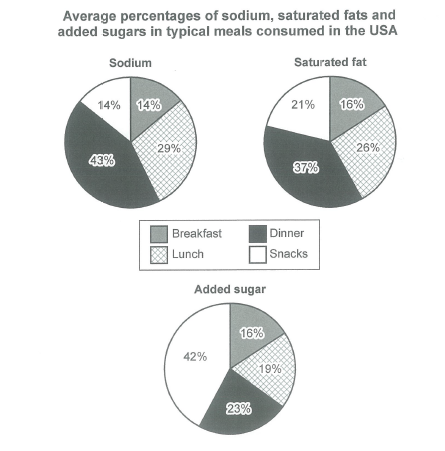
The charts below show the average percentages in typical meals of three types of nutrients, all of which may be unhealthy if eaten too much.
Summarize the information by selecting and reporting the main features, and make comparisons where relevant.
Student answer (Band 5.5)
The pie charts illustrate the average percentages of three nutrients, which are sodium, saturated fat and added sugar, in regular meals consumed in USA. The percentages are distributed four catagories: breakfast, lunch, dinner and snacks.
Both sodium and saturated fat are consumed at highest level in dinner, which is 43% sodium and 37% staurated fat. Sodium is consumed equally in breakfast and snacks (14%). For saturated fat, this percentages are non-equal, 16% and 21% respectively. In the lunch, 29% sodium and 26% saturated fat are consumed.
On the other hand, added sugar is mostly comes form sncks, which is 42%. And it comes lowest from breakfast (16%), which is also equal to the saturated fat's percentage. Though sodium and saturated fat consumed most in dinner, added sugar isn't the highest in that catagory. It consumed 23% in dinner and 19% in lunch.
All three nutrients are consumed in distincts percentages in different catagories.
AI examiner evaluation
| Criterion | Band |
|---|---|
| Task Achievement / Task Response | 5.5 |
| Coherence and Cohesion | 6.0 |
| Lexical Resource | 5.5 |
| Grammatical Range and Accuracy | 5.5 |
| Overall | 5.5 |
Task Achievement / Task Response: Band 5.5
You identify the three nutrients and report several key figures accurately, including dinner as the highest meal for sodium and saturated fat, and snacks as the highest for added sugar. The comparison that sodium is equal in breakfast and snacks is also relevant. However, the overview is weak: “All three nutrients are consumed in distincts percentages” does not clearly summarise the main pattern, and the response gives limited synthesis across the charts. Some descriptions are also imprecise, such as saying nutrients “are consumed” in these percentages rather than explaining that the charts show each meal’s share. A clearer overview contrasting dinner’s prominence for sodium and saturated fat with snacks’ prominence for sugar, followed by more selective comparisons, would make the report more complete.
Coherence and Cohesion: Band 6.0
The response has a generally clear sequence: it introduces the charts, discusses sodium and saturated fat, then turns to added sugar. Paragraphing helps separate the main points, and linking phrases such as “On the other hand” and “Though” signal contrast. However, some connections are mechanical or unclear. “This percentages” does not clearly refer to the two saturated-fat figures, while “It consumed 23% in dinner” leaves the subject and meaning uncertain. The final sentence repeats the idea that the percentages differ without adding a useful conclusion. Improve progression by grouping the strongest comparisons together and using precise references to the nutrient and meal, rather than relying on vague “it” or repeating general statements.
Lexical Resource: Band 5.5
You use relevant task vocabulary, including “average percentages,” “sodium,” “saturated fat,” “added sugar,” and “highest,” so the main information is understandable. There is some variation in how you describe comparisons, but the range is limited and several choices are inaccurate or awkward. For example, “mostly comes form sncks” contains spelling errors and an unsuitable phrase, while “consumed at highest level” is not a natural collocation for describing chart proportions. “Distincts percentages” is also an incorrect word form. These slips make the report less precise, although the intended meaning is usually recoverable. Aim for accurate chart language such as “accounted for,” “made up,” and “the largest share,” and check spelling and word forms carefully.
Grammatical Range and Accuracy: Band 5.5
You attempt both simple statements and more complex comparisons, for example, “Though sodium and saturated fat consumed most in dinner, added sugar isn't the highest in that catagory.” This shows an effort to connect ideas, but some sentence patterns are faulty. In “added sugar is mostly comes,” the verb forms are combined incorrectly; “this percentages are” has a number-agreement error; and “It consumed 23% in dinner” lacks a clear grammatical subject construction. Articles and prepositions also need attention in phrases such as “in USA” and “in the lunch.” These errors do not prevent the reader from following most figures, but they reduce accuracy. Practise consistent subject–verb patterns and use forms such as “added sugar accounts for” and “the figure for dinner is.”
See this exact question answered at other band scores. The same prompt compared across bands.
Browse more IELTS Writing model answers or get your own writing scored by the same AI examiner.