Band 4.5 IELTS Writing Task 1 Model Answer
Overall Band Score: 4.5 · Cambridge IELTS 14 · 2026-11-11
IELTS Writing Task 1 question
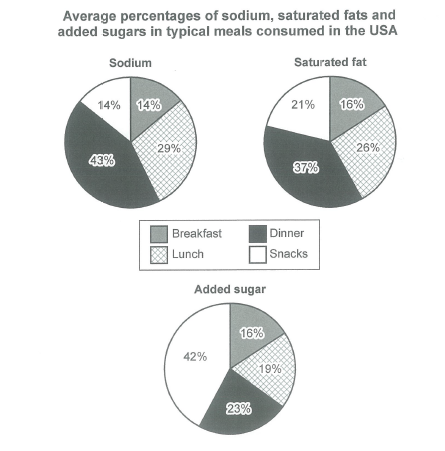
The charts below show the average percentages in typical meals of three types of nutrients, all of which may be unhealthy if eaten too much.
Summarize the information by selecting and reporting the main features, and make comparisons where relevant.
Student answer (Band 4.5)
This pic chart shows the percentages of four tipical meals in Sodium, Saturated fat, and Added suger this four are effected or unhealthy if eaten too much.
Dinner is a bigest in both in sodium 43% and saturated fat 37% and in suger 23% this is unhealthey. Snakes is highest in snakes 42% but other is lowest in all charts.
AT first sodium in sodium breakfast is and snakes are equal 14% this is lowest percentage in this chart, Lunch 29% this is bigest in all charts, Dinner is bigest in sodium 43% this is very unhealthy if eaten too much.
2nd is saturated fat dinner is against is higheest in this chart 37%, Lunch is 2nd highest 26%, Break fast 16% provided, and at last snakes is 21% provided.
In suger the patren is changed snakes is the highest 43% in all of charts, dinner is 23% in this chart, In lunch 19% provided, and at the last break fast is only 16% in this chart.
AI examiner evaluation
| Criterion | Band |
|---|---|
| Task Achievement / Task Response | 5.0 |
| Coherence and Cohesion | 4.5 |
| Lexical Resource | 4.5 |
| Grammatical Range and Accuracy | 4.5 |
| Overall | 4.5 |
Task Achievement / Task Response: Band 5.0
You identify several important patterns, especially that dinner has the highest sodium and saturated-fat shares, while snacks account for the most added sugar. However, the report only partially covers the data because some comparisons are inaccurate or unclear. For example, you say lunch is the “bigest in all charts,” although dinner is highest for sodium and saturated fat; you also give snacks’ added sugar as 43%, rather than 42%. The statement that snacks are “lowest in all charts” is also incorrect: breakfast and snacks tie for the lowest sodium share, while breakfast is lowest for saturated fat and added sugar. Include a concise, accurate overview and check each figure before comparing it.
Coherence and Cohesion: Band 4.5
The response has some organisation: it moves from a brief opening to separate discussions of sodium, saturated fat and sugar. This gives the reader a basic route through the information. However, progression is weakened by repeated or confusing phrasing, such as “Dinner is a bigest” followed by “Dinner is bigest in sodium,” and by the unclear sentence “Snakes is highest in snakes.” The transitions “AT first” and “2nd” are mechanical, and the paragraph breaks do not consistently support clear comparisons. Group the information into an introduction, an overview of the main contrasts, and focused detail paragraphs; use linking phrases that show comparisons rather than simply announcing the next chart.
Lexical Resource: Band 4.5
You use some relevant chart vocabulary, including “percentages,” “highest,” “lowest” and “provided,” and the reader can generally recognise the topic. However, the range is limited and several word-choice, collocation and spelling problems make the report less clear. “Snakes” appears to be a mistaken form of “snacks,” while “bigest,” “suger,” “unhealthey” and “patren” are misspelled. Phrases such as “highest in snacks” and “Dinner is a bigest” are not natural ways to describe the figures. Aim for precise reporting language such as “accounted for,” “share” and “was the largest proportion,” and proofread spellings and word forms carefully.
Grammatical Range and Accuracy: Band 4.5
The response communicates some comparisons through short statements, but its sentence structures are mostly simple and frequently incomplete or faulty. For instance, “Dinner is a bigest in both in sodium 43%” lacks a clear grammatical structure, and “breakfast is and snakes are equal 14%” does not form a complete, accurate comparison. Articles and sentence boundaries are also problematic, as in “this is bigest in all charts,” while several clauses are joined without clear punctuation. These errors sometimes make the intended relationship between figures difficult to follow. Practise complete comparative sentences, for example, “Dinner accounted for 43% of sodium, compared with 29% at lunch,” and use punctuation to separate each main point.
See this exact question answered at other band scores. The same prompt compared across bands.
Browse more IELTS Writing model answers or get your own writing scored by the same AI examiner.