Band 5.0 IELTS Writing Task 1 Model Answer
Overall Band Score: 5.0 · Cambridge IELTS 14 · 2026-11-11
IELTS Writing Task 1 question
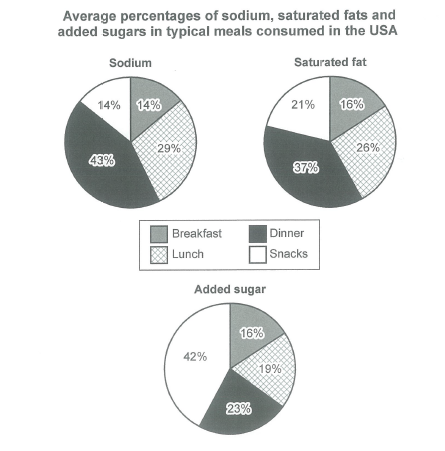
The charts below show the average percentages in typical meals of three types of nutrients, all of which may be unhealthy if eaten too much.
Summarize the information by selecting and reporting the main features, and make comparisons where relevant.
Student answer (Band 5.0)
The pea graph illustrates how much sodium and sturated fat and sugar provide on evry meals in the usa.
Overll , the sodium is the most hugher percentage in the dinner and on the secound pea that conten saturated fat its also fund the most on dinner.
Morover, the dinner come first by 43 percentage of sodium and on secoud we have lunch that proved 29 percentage , on the saturated fat it also found the most in dinner and secoundly on lunch by 37 and 26 percentage respactly .
The last pea shart we see thar added suger found most on snacks by 42 percentage
AI examiner evaluation
| Criterion | Band |
|---|---|
| Task Achievement / Task Response | 5.0 |
| Coherence and Cohesion | 5.0 |
| Lexical Resource | 5.0 |
| Grammatical Range and Accuracy | 5.0 |
| Overall | 5.0 |
Task Achievement / Task Response: Band 5.0
You identify several relevant features, including dinner as the highest meal for sodium and saturated fat, and snacks as the highest for added sugar. You also report some accurate figures, such as 43% sodium at dinner and 42% added sugar in snacks. However, the summary is partial: it omits the breakfast figures and does not clearly compare all four meals for added sugar. The saturated-fat comparison is also confusing: 37% and 26% are the dinner and lunch values, but the sentence does not clearly attach each value to its meal. The response is 106 words, below the required 150, so the key features are under-developed. Include a fuller overview and more precise comparisons.
Coherence and Cohesion: Band 5.0
There is a basic attempt to organise the response: an opening sentence is followed by an overview and then details about sodium, saturated fat and added sugar. Linking expressions such as “Overall” and “Moreover” help signal this structure. However, the progression is not consistently clear, and the repeated references to the “second pie” make it difficult to follow which nutrient is being discussed. Some comparisons are compressed into long sentences, especially the sentence combining sodium and saturated-fat figures. Use separate, clearly grouped sentences for each nutrient, and make the meal labels explicit beside each figure. This would improve the organisation and reduce the reader’s need to infer connections.
Lexical Resource: Band 5.0
The response uses some task-relevant vocabulary, including “percentage,” “sodium,” “saturated fat,” “dinner” and “snacks,” so the main subject is generally recognisable. However, the range is limited and several noticeable spelling and word-choice errors make the description harder to read, such as “pea graph,” “sturated,” “evry,” “hugh(er)” and “suger.” “Come first” and “found the most” are also imprecise ways to describe chart values. Use standard chart language such as “pie chart,” “accounted for,” “was highest in” and “followed by.” Check spelling carefully and avoid repeating the same basic phrasing when comparing the three nutrients.
Grammatical Range and Accuracy: Band 5.0
You attempt to form connected sentences and use an overview marker, but the grammatical range is limited and errors occur frequently. For example, “The pea graph illustrates how much … provide on evry meals” has an unclear clause structure and incorrect agreement; “the dinner come first” also has a subject–verb agreement error. The sentence beginning “on the saturated fat” joins several ideas without clear grammatical relationships, making the figures difficult to interpret. Most sentences rely on simple patterns, with little accurate variation. Practise writing one complete sentence per comparison, using structures such as “Dinner accounted for 43% of sodium, compared with 29% at lunch.” Check articles, agreement and sentence boundaries.
See this exact question answered at other band scores. The same prompt compared across bands.
Browse more IELTS Writing model answers or get your own writing scored by the same AI examiner.