Band 6.0 IELTS Writing Task 1 Model Answer
Overall Band Score: 6.0 · Cambridge IELTS 14 · 2026-11-11
IELTS Writing Task 1 question
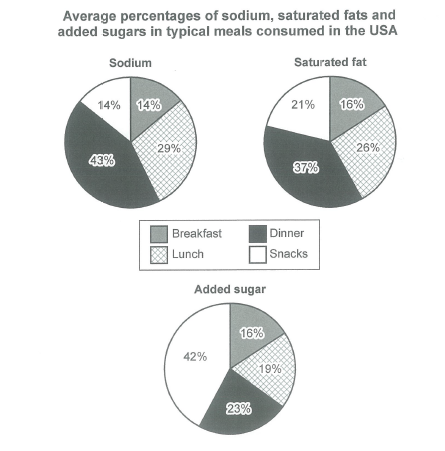
The charts below show the average percentages in typical meals of three types of nutrients, all of which may be unhealthy if eaten too much.
Summarize the information by selecting and reporting the main features, and make comparisons where relevant.
Student answer (Band 6.0)
The pie chart illustrate the proportion in everyday meals of three unhealthy nutrients- sodium, saturated fat and added sugar.
Overall, the biggest amount of sodim and saturated fat is in the dinner and the majority of added sugar in tha snacks. The lowest amount of sodium and saturated fats are in breakfast and snacks, while the lowest amount of added sugar is the breakfast and lunch.
The percentage of sodium and saturated fats is close in all meals. The majority approximately 40% are in dinner, followed by around 27.5% in lunch. The smallest amount is in breakfast with around 15%, after which are the snacks with again 14% sodium and 21% saturated fat.
The majority of added sugar is in the snacks with 42%, followed by the dinner with 23%. The amount in the breakfast and in the lunch is the smallest, with 19% in tha lunch and just 16% in the breakfast.
AI examiner evaluation
| Criterion | Band |
|---|---|
| Task Achievement / Task Response | 7.0 |
| Coherence and Cohesion | 6.5 |
| Lexical Resource | 5.5 |
| Grammatical Range and Accuracy | 5.5 |
| Overall | 6.0 |
Task Achievement / Task Response: Band 7.0
The response identifies the main patterns accurately: dinner has the highest shares of sodium and saturated fat, while snacks lead for added sugar. It also includes relevant comparisons across meals and gives an overview, so the key features are clearly addressed. However, some figures are imprecise or misreported: sodium at lunch is 29%, not part of a combined estimate of around 27.5%, and the lowest added-sugar values are 16% at breakfast and 19% at lunch, rather than both being described as the smallest without a clear distinction. The claim that sodium and saturated-fat percentages are “close in all meals” also over-generalises, especially for snacks. More precise reporting of the chart’s values and comparisons would strengthen the support for the overview.
Coherence and Cohesion: Band 6.5
The response has a clear overall structure: an introduction, an overview, and two paragraphs grouping sodium and saturated fat before added sugar. This makes the main comparisons easy to follow, and linking expressions such as “Overall,” “followed by,” and “while” help signal relationships. To make the progression more controlled, avoid repeating “the majority” and “the smallest amount” and organise comparisons more consistently—for example, report the highest and lowest meal for each nutrient before giving intermediate figures. Some references are also slightly unclear, such as “after which are the snacks,” which interrupts the flow. More precise linking and reference would help the cohesion feel less mechanical.
Lexical Resource: Band 5.5
The response uses relevant chart vocabulary, including “proportion,” “percentage,” “followed by,” and “majority,” and the reader can understand the comparisons being made. However, the range is limited and several choices are inaccurate or unnatural, which keeps the description from being consistently precise. “Biggest amount” and “smallest amount” are repeated where “highest proportion” and “lowest share” would be more suitable. “The percentage … is close” is also an awkward collocation, and “in the dinner” is not the natural way to describe a meal category. Spelling slips such as “sodim” and “tha” further reduce accuracy. Aim for varied, standard chart-reporting phrases and check spelling carefully.
Grammatical Range and Accuracy: Band 5.5
The response attempts a range of sentence forms, including comparisons with “while” and participial phrasing such as “followed by around 27.5% in lunch.” Most sentences remain understandable, but grammatical control is inconsistent. The opening needs subject–verb agreement: “The pie chart illustrate” should be “The pie chart illustrates.” There are also article and number-pattern problems in phrases such as “in the dinner” and “the lowest amount of added sugar is the breakfast and lunch.” The sentence beginning “The smallest amount is in breakfast” has an unclear follow-on clause, and punctuation around the nutrient list could be cleaner. Practise accurate agreement, articles, and complete comparison structures while retaining the variety of sentence patterns attempted here.
See this exact question answered at other band scores. The same prompt compared across bands.
Browse more IELTS Writing model answers or get your own writing scored by the same AI examiner.