Band 4.0 IELTS Writing Task 1 Model Answer
Overall Band Score: 4.0 · Cambridge IELTS 14 · 2026-11-11
IELTS Writing Task 1 question
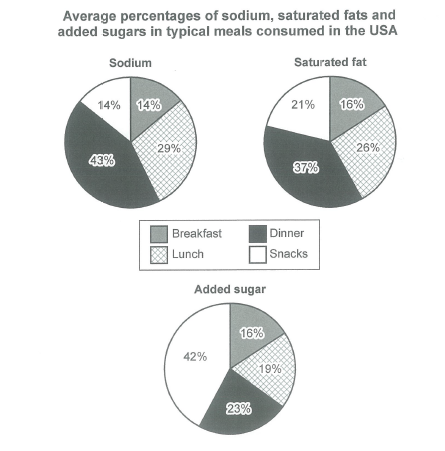
The charts below show the average percentages in typical meals of three types of nutrients, all of which may be unhealthy if eaten too much.
Summarize the information by selecting and reporting the main features, and make comparisons where relevant.
Student answer (Band 4.0)
CHART SHOW THE AVERAGE PERCENTAGE OF SODIUM IN BREAKFAST IS 14 PERCENTAGE, IN DINNER 43 PERCENTAGE, IN SNACK 14 PERCENT AND IN LUNCH IS 43 PERCENT. IF I SEE IN CHART THE SUGAR IN SNACKS IS 42 PERCENT, IN LUNCH IS 19 PERCENT, IN DINNER IS 23 PERCENT AND IN BREAKFAST IS 16 PERCENT. IF I SEE IN CHART THE SATURATED FAT IN SNACK IS 21 PERCENT, IN LUNCH IS 26 PERCENT, IN DINNER IS 37 PERCENT AND IN BREAKFAST IS 16 PERCENT. I HAVE WRITTEN ABOUT THIS CHART. I THINK I HAVE WRITTEN GOOD ABOUT THIS CHART. WHAT DO YOU I WROTE WELL OR NOT. YOU CAN MAKE AN OPPINION. AND CAN MAKE A GOOD RESULT OR BAD. MANY PEOPLE LEARN ABOUT HOW TO READ CHART. SOME PEOPLE READ CAREFULLY AND SOME PEOPLE DO NOT REAL WELL. PEOPLE FROM UNITED STATE OF AMERICA USED LESS SUGAR ITEMS BUT PEOPLE OF PAKISTAN USE ALOT OF SUGAR ITEMS
AI examiner evaluation
| Criterion | Band |
|---|---|
| Task Achievement / Task Response | 4.0 |
| Coherence and Cohesion | 3.5 |
| Lexical Resource | 4.5 |
| Grammatical Range and Accuracy | 4.5 |
| Overall | 4.0 |
Task Achievement / Task Response: Band 4.0
You report figures for all three nutrients, and most match the chart: for example, you correctly give dinner as 43% for sodium and snacks as 42% for added sugar. However, you misreport lunch sodium as 43%; the chart shows 29%. More importantly, the response does not provide a clear overview of the main patterns, such as dinner having the highest sodium and saturated-fat shares while snacks have the highest added-sugar share. The comments about how well you wrote and about people in Pakistan are not supported by the chart and do not answer the task. This makes the response only a minimal, partly tangential summary. Focus on the chart’s key comparisons and omit personal comments or unsupported claims.
Coherence and Cohesion: Band 3.5
The response has a basic sequence: it gives figures for sodium, then sugar, then saturated fat. This helps the reader identify which nutrient each set of numbers concerns. However, the ideas are not arranged as a clear report: there is no introduction or overview, and the repeated openings “IF I SEE IN CHART” and “I HAVE WRITTEN ABOUT THIS CHART” interrupt the progression. The final comments about learning to read charts and Pakistan shift away from the data without a logical link. Group the information into a short introduction, an overview of the main contrasts, and detail paragraphs comparing the meal types. Use linking phrases to show comparisons rather than repeating the same opening.
Lexical Resource: Band 4.5
You use basic chart-related vocabulary, including “average percentage,” “sodium,” “sugar,” and “saturated fat,” so the reader can generally identify the subject and figures. However, the vocabulary is repetitive and some expressions are imprecise or unsuitable for an academic report, such as “I have written about this chart” and “make a good result or bad.” “Sugar items” and “a lot of sugar items” are also vague descriptions of the chart’s added-sugar percentages. Use concise reporting language and precise terms for the data, such as “accounted for,” “proportion,” and “added sugar.” Check spelling and word forms, including “opinion,” and avoid informal or unrelated wording.
Grammatical Range and Accuracy: Band 4.5
Most of the response uses short, simple statements, and the repeated “X is Y percent” pattern makes several figures understandable. However, grammatical control is inconsistent: “CHART SHOW” lacks an appropriate subject and verb form, while “in lunch is 43 percent” has an awkward sentence structure and also reports the wrong figure. The question “WHAT DO YOU I WROTE WELL OR NOT” is not formed correctly, and the final sentences shift between “used” and “use” without a clear, controlled time reference. Sentence boundaries and punctuation are also weak because much of the response is written in capitals as a long sequence. Practise complete subject–verb sentences and use a few accurate comparison structures, such as “Dinner accounts for a larger share than breakfast.”
See this exact question answered at other band scores. The same prompt compared across bands.
Browse more IELTS Writing model answers or get your own writing scored by the same AI examiner.