Band 5.5 IELTS Writing Task 1 Model Answer
Overall Band Score: 5.5 · Cambridge IELTS 14 · 2026-11-11
IELTS Writing Task 1 question
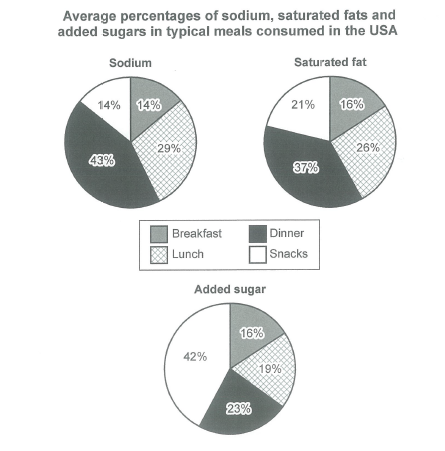
The charts below show the average percentages in typical meals of three types of nutrients, all of which may be unhealthy if eaten too much.
Summarize the information by selecting and reporting the main features, and make comparisons where relevant.
Student answer (Band 5.5)
The given charts illustrate the average percentile in typical meals of three kinds of nutrients consumed by people in the USA.
The consumer usually like to eat sodium and saturated fat in dinner while added sugar is in snacks. There is lesser amount of sodium present in snacks.
The 43% of sodium and 37% of saturated fat commonly favourit during dinner time. The people are less interested in sodium and saturated fat during breakfast which is 14% and 16% respectively. Fries contain 14% of sodium, 21% of saturated fat with 42% of added sugar. All of these nutrients become dangerus for health if taken too much. In other words, health of citizens in the USA will be in risk if they eat snacks in larger amount. Also the diet they choose on dinner will also be dangerous.
In conclusion, consumer in United State should consume healthy and reasonable food in dinner and they should avoid chips to overcome possible negative effect on health.
AI examiner evaluation
| Criterion | Band |
|---|---|
| Task Achievement / Task Response | 5.5 |
| Coherence and Cohesion | 5.5 |
| Lexical Resource | 5.5 |
| Grammatical Range and Accuracy | 5.5 |
| Overall | 5.5 |
Task Achievement / Task Response: Band 5.5
You identify the main pattern that sodium and saturated fat are highest at dinner, while added sugar is highest in snacks, and you include several accurate figures, such as 43% sodium and 37% saturated fat at dinner. However, the account is only partial: it does not clearly compare all four meal categories or give a balanced overview of the chart. The statement that people are “less interested” in these nutrients also interprets the figures as preferences, which the chart does not show. In addition, “Fries” is not a chart category; the 14%, 21% and 42% figures refer to snacks. Focus on describing the proportions, and include the contrasting pattern that snacks have the most added sugar but relatively little sodium.
Coherence and Cohesion: Band 5.5
The response has a basic sequence: an introduction, a summary of selected figures, and a concluding statement. This gives the reader some organisation, and phrases such as “In other words” and “In conclusion” signal relationships between ideas. However, the progression is not consistently clear because chart reporting is mixed with unsupported health advice, including the claims about citizens being at risk and avoiding chips. The figures are also presented without a systematic comparison across meals, and the conclusion repeats advice rather than summarising the main data. Group the information into a clear overview and comparison paragraphs, and use linking expressions to show contrasts between dinner, snacks, lunch and breakfast.
Lexical Resource: Band 5.5
You use some relevant topic vocabulary, including “sodium,” “saturated fat,” “added sugar,” and “nutrients,” so the subject is generally understandable. However, the range is limited and several word choices or collocations are inaccurate: “average percentile” should be “average percentage,” “favourit” is not the appropriate form, and “Fries” mislabels the chart’s snack category. Expressions such as “consumer usually like to eat” and “less interested” describe preferences rather than the proportions shown. Spelling errors such as “dangerus” also reduce accuracy. Aim for precise chart language, for example “accounted for,” “proportion,” and “was highest in,” and avoid adding food examples that are not provided.
Grammatical Range and Accuracy: Band 5.5
The response includes mostly short, simple statements and attempts a few longer structures, such as “All of these nutrients become dangerus for health if taken too much.” However, errors in sentence construction and agreement are frequent enough to make some sentences awkward or unclear. For example, “The consumer usually like” has a subject–verb agreement problem, while “The 43% of sodium and 37% of saturated fat commonly favourit during dinner time” lacks a correctly formed verb phrase. “Consumer in United State should consume” also has problems with number and article use. Practise building complete sentences with accurate subjects and verbs, and use a wider mix of simple and complex structures while checking agreement, articles and punctuation.
See this exact question answered at other band scores. The same prompt compared across bands.
Browse more IELTS Writing model answers or get your own writing scored by the same AI examiner.