Band 5.5 IELTS Writing Task 1 Model Answer
Overall Band Score: 5.5 · Cambridge IELTS 14 · 2026-11-11
IELTS Writing Task 1 question
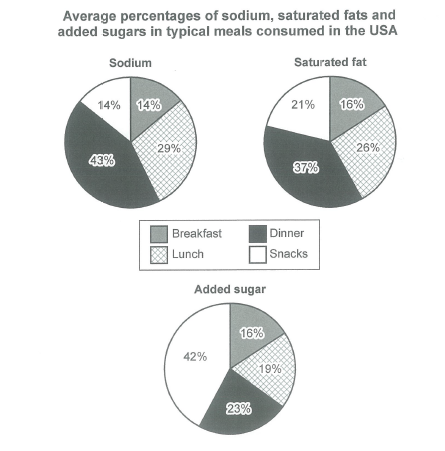
The charts below show the average percentages in typical meals of three types of nutrients, all of which may be unhealthy if eaten too much.
Summarize the information by selecting and reporting the main features, and make comparisons where relevant.
Student answer (Band 5.5)
The pie charts illustrate the average proportion in typical meals of 3 types of nutrients, which if consumed too much, it may become unhealthy for us.
Overall, in USA, saturated fat and sodium are mostly consumed nutrients in the dinner, while these 2 nutrients along with sugar, is consumed least in the breakfast.
In the breakfast, sodium is consumed 14% of the proportion, while fat and sugar remains sam.
Dinner contains maximum amount of percentage of sodium and fat while its only 23% in sugar.
while lunch is a category where sodium and fat are eaten 29% and 26% respectively, and sugar is as low as 19%. Finally, snacks contained majority of sugar content and least amount of sodium, and 21% of fat.
AI examiner evaluation
| Criterion | Band |
|---|---|
| Task Achievement / Task Response | 5.5 |
| Coherence and Cohesion | 5.5 |
| Lexical Resource | 5.5 |
| Grammatical Range and Accuracy | 5.0 |
| Overall | 5.5 |
Task Achievement / Task Response: Band 5.5
You identify the main pattern that dinner has the highest shares of sodium and saturated fat, while snacks lead in added sugar, and you include several relevant figures. However, the overview is not fully accurate: breakfast is not the lowest meal for all three nutrients, since snacks also have 14% sodium, below breakfast’s 14% only as a tie, and breakfast’s 16% saturated fat is lower than snacks’ 21% but not the lowest for sugar, which is also 16% at breakfast. Some comparisons are incomplete, and the response is 27 words below the required minimum, limiting the detail reported. To strengthen the summary, state the key contrasts precisely and cover all four meals more fully.
Coherence and Cohesion: Band 5.5
The response has a recognisable structure: an introduction, an overall statement, and details about breakfast, dinner, lunch and snacks. This gives the reader a basic route through the information. However, the progression is not consistently clear: the meal-by-meal details are compressed into one paragraph, and the shift from breakfast to dinner begins with a lower-case “while.” Connections such as “Finally” help, but several sentences read as separate observations rather than a smoothly organised comparison. Grouping the meals with the highest values together, then contrasting the lower values, would make the key patterns easier to follow. Clearer sentence boundaries and more deliberate linking would also improve cohesion.
Lexical Resource: Band 5.5
You use relevant chart vocabulary, including “proportion,” “maximum amount,” “category,” and “majority,” and the reader can generally understand which nutrient and meal you mean. However, some word choices and collocations are inaccurate or repetitive: “saturated fat and sodium are mostly consumed nutrients in the dinner” is awkward, while “sugar content” and “percentage” are used without consistently precise phrasing. “Remains sam” also contains a spelling error and does not communicate the intended comparison clearly. Aim for concise reporting language such as “accounted for,” “highest share,” and “lowest proportion,” while using “added sugar” consistently to match the chart. This would make the description more precise and natural.
Grammatical Range and Accuracy: Band 5.0
The response attempts both simple statements and longer sentences, but control is uneven, and errors sometimes make relationships between ideas unclear. For example, “which if consumed too much, it may become unhealthy” has a faulty relative-clause structure, and “these 2 nutrients along with sugar, is consumed least” has subject–verb agreement problems. The sentence beginning “while lunch is a category” is also awkwardly joined to the preceding point, and punctuation is inconsistent, including the lower-case “while” after a full stop. Practise building accurate comparisons with clear subjects and verbs, such as “Dinner accounts for the highest share of sodium.” More reliable sentence boundaries would help your ideas come across clearly.
See this exact question answered at other band scores. The same prompt compared across bands.
Browse more IELTS Writing model answers or get your own writing scored by the same AI examiner.