Band 5.5 IELTS Writing Task 1 Model Answer
Overall Band Score: 5.5 · Cambridge IELTS 14 · 2026-11-12
IELTS Writing Task 1 question
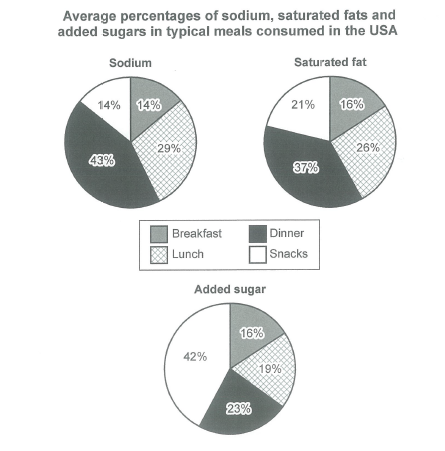
The charts below show the average percentages in typical meals of three types of nutrients, all of which may be unhealthy if eaten too much.
Summarize the information by selecting and reporting the main features, and make comparisons where relevant.
Student answer (Band 5.5)
The cart shows the mean percentage in daily food contain of sodium, saturated fat, sugar. If they were not balanced thge its unhealty.
Overall, consumption of all three nutrients in dinner is very high and usage of those in breakfast is less compare to other. Lush and snaks are volitale in the prespective of these nutrients.
In the breakfast, average consumption of sodium is 14% while sugur and saturated fat is same as 16%. Eating snacks on averge day by an american gay is containing a wide veraity of sugar its percentage is 42%. Sodium is 14% and Saturated fat is 21 out of hunded percent.
In the dinner, usually a human cosume 43 % of sodium at a time. 37% of its dinner is saturated fat in a day and 23% sugur involve in your average meal.
Lunch contain just 19% sugar and 26% saturated fat inside it. Consuption of sugur in a single day in a luch is 29%.
AI examiner evaluation
| Criterion | Band |
|---|---|
| Task Achievement / Task Response | 5.5 |
| Coherence and Cohesion | 5.5 |
| Lexical Resource | 5.0 |
| Grammatical Range and Accuracy | 5.0 |
| Overall | 5.5 |
Task Achievement / Task Response: Band 5.5
You identify relevant features, including dinner’s high sodium and saturated-fat shares and the 42% added-sugar figure for snacks. You also report several accurate values for breakfast and lunch. However, the overview is not fully reliable: breakfast is not the lowest meal for every nutrient, since snacks also have 14% sodium, and lunch is not clearly “volatile.” More importantly, the final sentence says lunch contains 29% sugar, but that figure is sodium; lunch’s added sugar is 19%. The response reports many figures but gives limited clear comparison across all three nutrients. A more precise overview and careful checking of which percentage belongs to each nutrient would make the key features clearer and more complete.
Coherence and Cohesion: Band 5.5
The response has a basic structure, moving from an introduction and overview to meal-by-meal details. This gives the reader some organisation, and the paragraphs generally group related information. However, progression is weakened by unclear or inaccurate links between ideas. For example, “Lush and snaks are volitale” does not explain the comparison, and the lunch paragraph ends by assigning 29% to sugar after previously giving lunch’s sugar as 19%. The sequence also shifts between meals without a consistent comparison pattern. Organise the details by nutrient or use the same meal order throughout, and connect comparisons explicitly—for example, contrast dinner’s 43% sodium with breakfast and snacks at 14%.
Lexical Resource: Band 5.0
You use some task-relevant terms, such as “average consumption,” “percentage,” “sodium,” and “saturated fat,” so the topic is generally recognisable. However, vocabulary is limited and several word choices or spelling errors make parts difficult to understand: “cart” for chart, “food contain,” “volitale,” and “a wide veraity of sugar” are examples. “Usage” is also an imprecise choice for the proportion of a nutrient in a meal. Aim for accurate chart language and consistent spelling, using phrases such as “the proportion of added sugar” or “accounted for.” This would improve precision and reduce the effort required to interpret your comparisons.
Grammatical Range and Accuracy: Band 5.0
You attempt both simple statements and longer sentences, but the range is limited and errors occur frequently enough to make some relationships unclear. For example, “If they were not balanced thge its unhealty” has an incomplete and faulty conditional structure, while “Sodium is 14% and Saturated fat is 21 out of hunded percent” lacks a clear grammatical relationship between the figures. There are also recurring problems with articles, agreement, and sentence construction, as in “Lunch contain just 19% sugar.” Use straightforward, complete sentences first, checking that each has a clear subject and verb. Then practise combining comparisons with accurate structures such as “whereas” and “while.”
See this exact question answered at other band scores. The same prompt compared across bands.
Browse more IELTS Writing model answers or get your own writing scored by the same AI examiner.