Band 5.5 IELTS Writing Task 1 Model Answer
Overall Band Score: 5.5 · Cambridge IELTS 14 · 2026-11-12
IELTS Writing Task 1 question
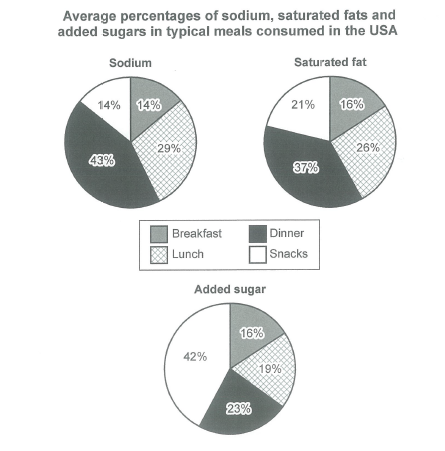
The charts below show the average percentages in typical meals of three types of nutrients, all of which may be unhealthy if eaten too much.
Summarize the information by selecting and reporting the main features, and make comparisons where relevant.
Student answer (Band 5.5)
The charts give the information on the average percentages in typical meals of three of nutrients, all of the unhealthy if eaten too much.
Overall, it is clear that there were significant difference in the main feature shown in the given information with some aspects being more prominent than the others.
First type contains sodium, large part in the sodium chart consist of dinner they have 43% and second kind contain lunch they have 29%. Snacks and breakfast form have same percentage, they consist of 14%.
Second type are saturated fat, the largest part in the chart contain dinner they consist of 37% and lunch contain 26%. Snacks consist of 21% and smallest part in the chart contain breakfast they have 16%. Final type are added sugar and in the chart they have four sectors. Largest sector contain snacks they have 42% and lunch consist of 19%. Breakfast contain 16% and last type are dinner they hold 23% in the chart.
AI examiner evaluation
| Criterion | Band |
|---|---|
| Task Achievement / Task Response | 5.5 |
| Coherence and Cohesion | 5.5 |
| Lexical Resource | 5.0 |
| Grammatical Range and Accuracy | 5.0 |
| Overall | 5.5 |
Task Achievement / Task Response: Band 5.5
You report the main figures for all three nutrients, and the comparisons are generally accurate: dinner is highest for sodium and saturated fat, while snacks lead for added sugar. You also identify the equal 14% shares for sodium in breakfast and snacks. However, the overview is vague: “significant difference” does not clearly summarise the key pattern across the charts. The response mainly lists individual meal values rather than selecting and comparing the most important features—for example, it could contrast dinner’s high sodium and saturated-fat shares with snacks’ high added-sugar share. The added-sugar figures are all included, but their order is confusing when dinner is described as the “last type” after breakfast. A clearer overview and more purposeful comparisons would make the report more complete.
Coherence and Cohesion: Band 5.5
The response has a basic, recognisable structure: an introduction, an overview, and separate paragraphs for the nutrient charts. This helps the reader follow the broad sequence from sodium to saturated fat and then added sugar. However, progression within the paragraphs is often list-like, and repeated patterns such as “they consist of” and “they have” make the report feel mechanical. Some references are unclear, as in “First type contains sodium” and “second kind contain lunch,” where the chart category and meal are not expressed precisely. The added-sugar figures are also presented in an order that makes the comparison harder to follow. Grouping the highest and lowest meal shares and using clearer links between comparisons would improve cohesion.
Lexical Resource: Band 5.0
You use relevant chart vocabulary, including “average percentages,” “largest part,” “smallest part,” and “sectors,” so the reader can understand that you are describing proportions. However, the range is limited and several phrases are unnatural or imprecise, such as “large part in the sodium chart consist of dinner” and “Breakfast contain 16%.” Repeated use of “contain,” “consist,” and “type” also reduces variety and makes some comparisons less clear. Choose standard language for describing data, such as “account for,” “share,” and “proportion,” and use meal names directly rather than “first type” or “second kind.” More precise collocations would make the report easier to read without changing its factual content.
Grammatical Range and Accuracy: Band 5.0
Most sentences use simple structures, and the reader can usually identify the meal and percentage being reported. However, errors occur frequently in agreement and sentence construction. For example, “there were significant difference” needs plural agreement, while “the largest part … contain dinner” has a subject–verb agreement problem and an unclear grammatical relationship between the part and dinner. In “First type contains sodium, large part …,” two clauses are joined without suitable punctuation or a linking structure. Articles and plural forms are also inconsistent, as in “three of nutrients” and “four sectors.” Work on accurate subject–verb agreement, complete sentence boundaries, and basic article use before attempting longer structures; this will make the comparisons clearer.
See this exact question answered at other band scores. The same prompt compared across bands.
Browse more IELTS Writing model answers or get your own writing scored by the same AI examiner.