Band 5.5 IELTS Writing Task 1 Model Answer
Overall Band Score: 5.5 · Cambridge IELTS 14 · 2026-11-12
IELTS Writing Task 1 question
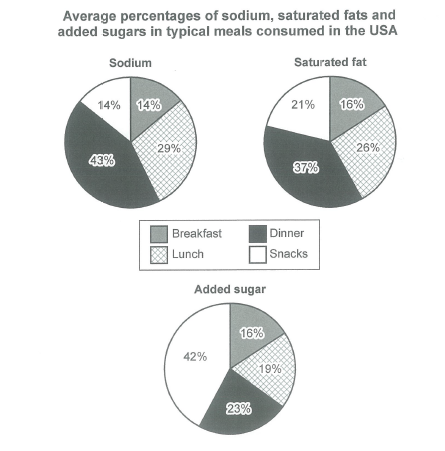
The charts below show the average percentages in typical meals of three types of nutrients, all of which may be unhealthy if eaten too much.
Summarize the information by selecting and reporting the main features, and make comparisons where relevant.
Student answer (Band 5.5)
The follwing pie charts illustrate the proportion of three types of nutrients namely sodium,saturated fat and added sugar consumed in US.
Overall it can be seen that sodium and saturated fat remain the most dominant in dinner with added sugar being most dominant in snacks .In contrast the usage of sodium is least in both breakfast and snacks whereas saturated fat is used in the least amount in breakfast matching the proportion of added sugar being used least in breakfast.
It can be observed that sodium remained most dominant in breakfast with a total of 43% usage along with being used with 14% proportion in both breakfast and lunch and also 29% in lunch.
Saturated fat is used almost 37% in dinner, 21% in snacks ,16% in breakfast and 26% in lunc.
Similarly 42% of snacks contain added sugar with 16% used in breakfast ,19% in lunch and the rest 23% in dinner
AI examiner evaluation
| Criterion | Band |
|---|---|
| Task Achievement / Task Response | 5.5 |
| Coherence and Cohesion | 5.5 |
| Lexical Resource | 5.5 |
| Grammatical Range and Accuracy | 5.5 |
| Overall | 5.5 |
Task Achievement / Task Response: Band 5.5
You identify the main contrast: dinner has the highest shares of sodium and saturated fat, while snacks lead for added sugar. You also include figures for all three nutrients, which gives the reader relevant detail. However, a key data error weakens the report: you say sodium is “most dominant in breakfast” at 43%, but 43% belongs to dinner; breakfast is 14%. You also describe sodium as 14% in both breakfast and lunch, although lunch is 29%. The overview’s claim that sodium is lowest in breakfast and snacks is accurate, but the body’s conflicting figures make the account unclear. Check each value against the chart and make the overview and supporting details consistent.
Coherence and Cohesion: Band 5.5
The response has a basic overall structure, moving from an introduction and overview to details about sodium, saturated fat and added sugar. “Overall” and “Similarly” help signal the purpose of some sentences, and the nutrient-by-nutrient grouping is understandable. However, progression is weakened by the sodium paragraph, which repeats “breakfast” and “lunch” while giving contradictory figures, so the reader cannot follow the comparison reliably. The overview also combines several points in a long sentence, and the body does not consistently organise comparisons across meals. Use separate, clearly focused paragraphs and group the most useful comparisons—for example, the highest meal for each nutrient, followed by the lower shares. Clearer sequencing and referencing would make the report easier to follow.
Lexical Resource: Band 5.5
You use relevant chart vocabulary, including “proportion,” “dominant,” “usage” and “consumed,” and the nutrient names are generally clear. However, the range is limited and some choices are unnatural or imprecise for describing percentages. “Most dominant” is redundant, while “used” and “usage” make the nutrients sound as if they are deliberately applied rather than present in meals. “Contain added sugar” is also less precise than describing the percentage of added sugar consumed in snacks. There are noticeable spelling and spacing errors, including “follwing” and “lunc,” which reduce accuracy. Aim for concise reporting language such as “accounted for,” “represented” and “share,” and proofread spelling and spacing.
Grammatical Range and Accuracy: Band 5.5
You attempt a few complex forms, such as “Overall it can be seen that…” and the contrast introduced by “whereas,” alongside simpler sentences listing percentages. However, sentence structures are repetitive, and control is uneven. The opening sentence lacks a comma after “sodium” in the list, and the overview sentence joins several comparisons in a way that makes the relationships difficult to track. The phrase “with a total of 43% usage” is grammatically possible but sits within a sentence whose comparison is confusing. Punctuation is also inconsistent, with missing spaces after commas in “sodium,saturated” and “breakfast and lunch and also 29%.” Practise accurate list punctuation and use shorter, complete comparison sentences.
See this exact question answered at other band scores. The same prompt compared across bands.
Browse more IELTS Writing model answers or get your own writing scored by the same AI examiner.