Band 5.0 IELTS Writing Task 1 Model Answer
Overall Band Score: 5.0 · Cambridge IELTS 14 · 2026-11-12
IELTS Writing Task 1 question
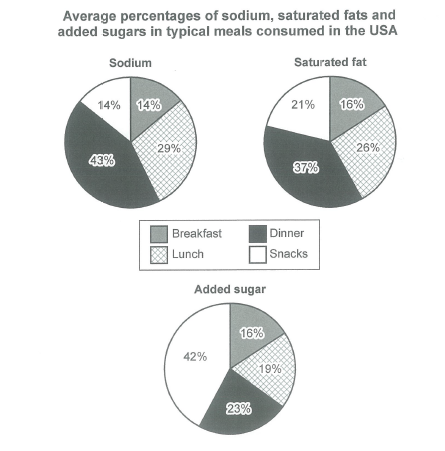
The charts below show the average percentages in typical meals of three types of nutrients, all of which may be unhealthy if eaten too much.
Summarize the information by selecting and reporting the main features, and make comparisons where relevant.
Student answer (Band 5.0)
The pie charts illustrates the average proportions in typical meals of three types of nutrients, all of which may be unhealthy if eaten too much
Overall, it is clear that the sodium average of accounted the largest value, and the satured fat the lowest point. And the remaining of the added sugar in these items.
In dinner, had the largest proportions to 43%, followed by lunch 29%. Breakfast and snacks are also remain the same value of the sodium positions to 14%. In Saturated fat snacks increases the proportions of 21%, and the breakfast also two percent rise up only 16%. Dinner ratio are the drop in the 37%, while the lunch 26%. In the added sugar, Snacks had the highest proportion in 42%, followd by dinner in 23% of the products. While the remain breakfast are also 16%, and the lunch of 19% of the added sugar of process.
AI examiner evaluation
| Criterion | Band |
|---|---|
| Task Achievement / Task Response | 5.5 |
| Coherence and Cohesion | 5.0 |
| Lexical Resource | 5.0 |
| Grammatical Range and Accuracy | 4.5 |
| Overall | 5.0 |
Task Achievement / Task Response: Band 5.5
You report the main meal patterns and include several accurate figures: dinner has the highest sodium share at 43%, while snacks lead for added sugar at 42%; you also compare lunch and breakfast values. However, the overview is unclear and partly inaccurate: sodium is not the largest value overall, since added sugar in snacks is 42% and sodium in dinner is 43%, while saturated fat is not consistently the lowest. The response also contains only 132 words, below the required 150, so the summary is underdeveloped. Add a clearer overview identifying dinner as the main source of sodium and saturated fat, and snacks as the main source of added sugar, then report the comparisons more precisely.
Coherence and Cohesion: Band 5.0
The response has a basic sequence: an introduction, an attempted overview, and details about sodium, saturated fat and added sugar. This gives the reader some sense of how the information is organised. However, progression is weakened by abrupt transitions and unclear links, such as “And the remaining of the added sugar in these items” and the repeated use of “In” to begin each data section. Several comparisons are crowded into long sentences, making it difficult to follow which meal or nutrient is being discussed. Use separate, clearly focused paragraphs and connect comparisons with accurate phrases such as “By contrast” or “Meanwhile.” Clearer referencing would also help the reader track each nutrient.
Lexical Resource: Band 5.0
You use relevant chart vocabulary, including “proportions,” “largest,” “followed by,” and “highest proportion,” and the nutrient names are generally identifiable. However, the range is limited and several word choices or collocations are inaccurate, which sometimes makes the meaning difficult to interpret. For example, “the sodium average of accounted the largest value” and “the added sugar of process” do not express the intended comparisons naturally. There are also spelling errors such as “satured” and “followd.” Aim for precise reporting language and check spelling: describe a meal as “accounting for” a share, or say that a nutrient “made up” a percentage. Avoid repeating “proportion” when “share” or “figure” would be clearer.
Grammatical Range and Accuracy: Band 4.5
The response attempts some sentence variety, including an opening overview and comparisons joined with “while,” but most structures are simple or incomplete, and errors occur throughout. For example, “The pie charts illustrates” has subject–verb disagreement, while “In dinner, had the largest proportions” lacks a clear subject and a complete clause. The sentence beginning “Overall” also contains faulty construction: “the sodium average of accounted.” These problems make several statements difficult to understand. Practise building complete sentences with a clear subject and verb, such as “Dinner accounted for 43% of sodium.” Check agreement, articles and punctuation, and use a controlled mix of simple and compound sentences before attempting more complex comparisons.
See this exact question answered at other band scores. The same prompt compared across bands.
Browse more IELTS Writing model answers or get your own writing scored by the same AI examiner.