Band 6.0 IELTS Writing Task 1 Model Answer
Overall Band Score: 6.0 · Cambridge IELTS 14 · 2026-11-12
IELTS Writing Task 1 question
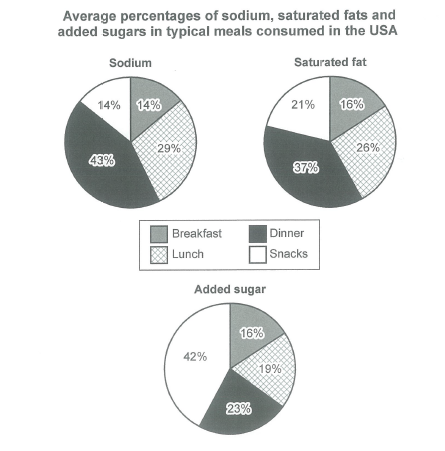
The charts below show the average percentages in typical meals of three types of nutrients, all of which may be unhealthy if eaten too much.
Summarize the information by selecting and reporting the main features, and make comparisons where relevant.
Student answer (Band 6.0)
The pie charts compares the average percentages of three kinds of nutrients in typical meals, all of these may be unhealthy if eaten in excess.
Overall, the highest proportion of sodium is mixed in dinner whereas the other two types of ingredients are about the same. In addition, a signifcant quantity of sugar is added in snacks while the proportion of other two kinds of nutrients are almost identical. Furthermore, all three types of nutrients have almost same in lunch.
It is clear that the dinner contains the highest percentage of sodium which is 43% while the other two types of nutrients also have significant share in dinner but itis almost same, with 37 and 23%. In addition, the largest share of sugar is added in snacks which is the 42% and sodium and saturated fat are mixed the almost same quantity, with 14% and 21% respectively. Furthermore, the lunch contains a significant part of saturated and sodium which is nearly the same, 26% and 29% repectively. However, breakfast has an important part of all three kinds of nutrients but almost same with 14% and 16%.
AI examiner evaluation
| Criterion | Band |
|---|---|
| Task Achievement / Task Response | 6.5 |
| Coherence and Cohesion | 6.0 |
| Lexical Resource | 5.5 |
| Grammatical Range and Accuracy | 5.5 |
| Overall | 6.0 |
Task Achievement / Task Response: Band 6.5
You identify the main patterns accurately: dinner has the highest sodium and saturated-fat shares, while snacks have the highest added sugar. The figures you give for these comparisons are correct, and you also make relevant observations about lunch and breakfast. This provides a clear overview and addresses the chart’s main features. However, the overview is not always precise: saying the “other two types of ingredients are about the same” in dinner is vague, and the claim that all three nutrients are “almost same in lunch” overlooks the lower added-sugar figure of 19% compared with sodium at 29% and saturated fat at 26%. To strengthen the response further, make comparisons more exact and cover the contrasts between meals consistently rather than describing some figures as merely “significant.”
Coherence and Cohesion: Band 6.0
The response has a clear overall arrangement, moving from an introduction and overview to supporting details. The repeated use of “In addition” and “Furthermore” helps signal that more information is coming, and the reader can follow the broad comparison between meals. However, these linking phrases are used mechanically, and several sentences combine multiple comparisons without a clear hierarchy. For example, the overview moves from dinner to snacks and then lunch, while the detail paragraph repeats those same points in a similar sequence. Grouping the information more deliberately—such as contrasting dinner with snacks, then summarising breakfast and lunch—would create stronger progression. Clearer references to each nutrient would also make relationships between figures easier to follow.
Lexical Resource: Band 5.5
You use relevant chart vocabulary, including “average percentages,” “proportion,” “share,” and “contains,” so the topic is generally clear. There is also some attempt to vary wording rather than relying only on “percentage.” However, several choices are inaccurate or unnatural for describing chart data: nutrients are not “mixed in” meals, and “a significant quantity of sugar is added in snacks” suggests an action rather than a proportion. Phrases such as “important part” and “almost same quantity” are also imprecise. Spelling slips such as “signifcant” and “repectively” further reduce accuracy. Aim for natural collocations such as “accounted for,” “made up,” and “the proportion of,” and check spelling during revision.
Grammatical Range and Accuracy: Band 5.5
You attempt a mix of simple and more complex sentences, including clauses introduced by “while” and “whereas,” and the main comparisons are usually understandable. Some grammatical errors remain, however. The opening should be “The pie charts compare,” because the plural subject requires a plural verb; “all of these may be unhealthy” is also an awkwardly joined clause. In “the other two types of nutrients are almost identical,” the comparison needs to refer to their proportions, not the nutrients themselves. There are further errors in “it is almost same” and “the lunch contains,” where article use and sentence construction need attention. Practise checking subject–verb agreement, articles, and complete clause structure while retaining your attempts at complex sentences.
See this exact question answered at other band scores. The same prompt compared across bands.
Browse more IELTS Writing model answers or get your own writing scored by the same AI examiner.