Band 5.0 IELTS Writing Task 1 Model Answer
Overall Band Score: 5.0 · Cambridge IELTS 14 · 2026-11-12
IELTS Writing Task 1 question
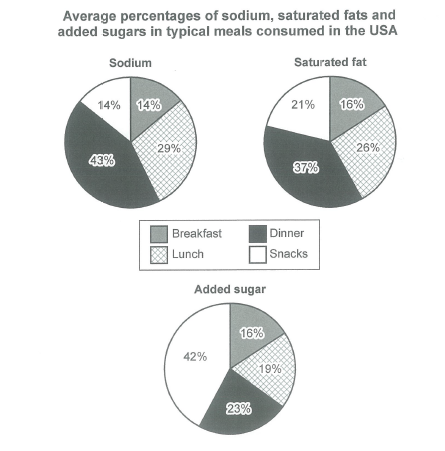
The charts below show the average percentages in typical meals of three types of nutrients, all of which may be unhealthy if eaten too much.
Summarize the information by selecting and reporting the main features, and make comparisons where relevant.
Student answer (Band 5.0)
The pie chart illustrate that the proption of three types of nutrients namely(Sodium,staurated fat, added suger) in meal, all of them may be unhealthy if consumed to much in USA.
Overall,The consumption of sodium percentage rose in dinner while in snacking the added suger fell up.In dinner, the saturated fat and added suger remain constant.
It is quite evident from the consumption of sodium rose in dinner whlie saturated fat and added suger steady less.In snacking the consumed added suger rose which is equal to approximately sum of saturated and added suger nutrients.
Furthermore,In lunch the consumption of sodium about 29% which is 3% more in saturated fat and also 10% greater them.In breakfast Two nutrients like (Added sugar , Saturated fat) samed but in sodium less consumed about 2%.
AI examiner evaluation
| Criterion | Band |
|---|---|
| Task Achievement / Task Response | 4.5 |
| Coherence and Cohesion | 4.5 |
| Lexical Resource | 5.0 |
| Grammatical Range and Accuracy | 5.0 |
| Overall | 5.0 |
Task Achievement / Task Response: Band 4.5
You identify the three nutrients and make some relevant comparisons, including the lunch figures and the equal breakfast shares for saturated fat and added sugar. However, the overview is unclear and includes inaccurate claims: added sugar does not fall during snacks; it reaches its highest share there, at 42%. Dinner values also do not remain constant: sodium is highest at 43%, while saturated fat and added sugar are 37% and 23%. The comparison that lunch sodium is “3% more” than saturated fat is incorrect, since the difference is three percentage points, and the following comparison is unclear. The response is also 20 words below the required minimum. Select the main highs and lows accurately, then support them with clear comparisons.
Coherence and Cohesion: Band 4.5
There is a basic attempt to organise the response into an opening, an overview and further details, and linking words such as “Overall” and “Furthermore” show an effort to guide the reader. However, the progression is difficult to follow because the overview repeats ideas from the next paragraph without clarifying them. For example, the statements about dinner being “steady” and added sugar rising in snacks are confusing and partly contradictory. Several comparisons are also hard to interpret, particularly “which is equal to approximately sum of saturated and added suger nutrients.” Use one paragraph for a concise overview and another for selected figures, and connect each comparison explicitly to the meal and nutrient being discussed.
Lexical Resource: Band 5.0
The response uses some relevant task vocabulary, including “consumption,” “percentage,” “nutrients,” and “approximately,” so the reader can recognise the general subject. However, the range is limited and several spelling and word-choice errors make the report less clear, such as “proption,” “staurated,” “suger,” and “snacking.” Some phrases are also unnatural or imprecise: “the consumption of sodium percentage rose” and “steady less” do not clearly describe the chart. Use standard chart language such as “accounted for,” “was highest,” and “made up,” and check spelling carefully. More precise terms for comparing values would help distinguish a percentage from a percentage-point difference.
Grammatical Range and Accuracy: Band 5.0
You attempt both simple statements and longer comparisons, but control is inconsistent, especially in the longer sentences. For example, “The pie chart illustrate” has subject–verb disagreement, while “In lunch the consumption of sodium about 29%” is missing a verb. The sentence beginning “It is quite evident from the consumption…” is not grammatically complete, and the final comparison has unclear structure. Capitalisation and punctuation are also inconsistent, with spaces missing after commas and full stops. Build accurate short sentences first—for example, “Sodium accounts for 29% at lunch”—then combine ideas using a clear comparative clause. This would make your meaning easier to follow while allowing you to show a wider range of structures.
See this exact question answered at other band scores. The same prompt compared across bands.
Browse more IELTS Writing model answers or get your own writing scored by the same AI examiner.