Band 5.5 IELTS Writing Task 1 Model Answer
Overall Band Score: 5.5 · Cambridge IELTS 14 · 2026-11-13
IELTS Writing Task 1 question
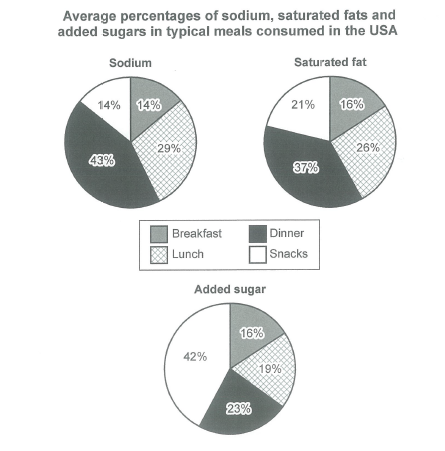
The charts below show the average percentages in typical meals of three types of nutrients, all of which may be unhealthy if eaten too much.
Summarize the information by selecting and reporting the main features, and make comparisons where relevant.
Student answer (Band 5.5)
Average percentage of added sugar, sodium and saturated fatin typical meals consumed in USA.
In sodium the percentage of breakfast is 14 percent and the same percentage of snacks, but the percentage of lunch 29% almost double snacks and breakfast, dinner percentage in sodium is very high it's 43%.
In saturated fats the percentage of breakfast is 16 percent and the percentage of snacks is 21% five percent more than breakfast, the percentage of lunch is 26% it's 3% less than sodium, the percentage of dinner is 37% it's 6% less than the sodium percentage.
Finally, the percentage of added sugar is 16% the same as saturated fat and the percentage of snacks is 42% it's very high as compare to the sodium and saturated fats, then the percentage of lunch is 19% less than to 10% of sodium and 7% of saturated fats, lastly the percentage of dinner is 23%.
To conclusion, the percentage of dinner is more than all gharphs and breakfast is less every gharaph.
AI examiner evaluation
| Criterion | Band |
|---|---|
| Task Achievement / Task Response | 6.0 |
| Coherence and Cohesion | 6.0 |
| Lexical Resource | 5.0 |
| Grammatical Range and Accuracy | 5.0 |
| Overall | 5.5 |
Task Achievement / Task Response: Band 6.0
You report the figures for all three nutrients and make relevant comparisons, including sodium at 14% for breakfast and snacks and dinner at 43%. You also identify the high snack share of added sugar. However, the overview is brief and partly inaccurate: “dinner is more than all gharphs” overlooks that snacks, at 42%, are the largest category for added sugar, while breakfast is not the lowest for every nutrient because sodium is tied with snacks. Some comparisons are also unclear, such as saying lunch added sugar is “less than to 10% of sodium”; the actual difference from sodium is 10 percentage points. A clearer overview of the contrasting peaks—dinner for sodium and saturated fat, snacks for sugar—would make the main features more complete and precise.
Coherence and Cohesion: Band 6.0
The response has a generally understandable sequence: it discusses sodium, saturated fat and added sugar in turn, then attempts a concluding summary. This gives the reader a basic framework for following the data. However, the repeated openings “In sodium,” “In saturated fats” and “Finally” make the organisation feel mechanical, and several long sentences join multiple comparisons with commas and “but” or “then.” This makes relationships between figures harder to follow, particularly in the added-sugar paragraph. The conclusion also does not clearly synthesise the key contrast across the charts. Use a distinct overview followed by logically grouped details, and separate comparisons into shorter sentences with clear linking phrases.
Lexical Resource: Band 5.0
You use relevant chart vocabulary such as “percentage,” “sodium,” “saturated fats” and “added sugar,” and phrases like “almost double” show an attempt to compare values rather than simply list them. However, the range is limited and several choices are inaccurate or unnatural, including “the percentage of dinner,” “as compare to,” and “less than to.” “Very high” is repeated instead of using more precise language to describe the largest or smallest shares. There are also spelling errors in “gharphs” and “gharaph,” which reduce the accuracy of the report. Aim for concise data-reporting expressions such as “accounted for,” “was higher than,” and “the largest proportion,” while checking spelling and collocations.
Grammatical Range and Accuracy: Band 5.0
You attempt to combine information in longer sentences, and the meaning of most figures can still be understood. However, sentence structures are often joined without clear grammatical control, as in “the percentage of lunch 29% almost double snacks and breakfast,” where a verb and a complete comparison structure are needed. The opening fragment, “Average percentage of added sugar…,” also lacks a main verb. Other issues include missing articles and prepositions, as in “consumed in USA,” and awkward comparison patterns such as “less than to 10%.” Punctuation is also weak in several comma-linked sentences. Practise writing complete sentences with a clear subject and verb, and use accurate patterns such as “Lunch accounted for 29%, almost twice the breakfast and snack figures.”
See this exact question answered at other band scores. The same prompt compared across bands.
Browse more IELTS Writing model answers or get your own writing scored by the same AI examiner.